3-Day Uyuni Tour Guide
The 3-day Uyuni tour is the ultimate route - salt flats, flamingo lagoons, geysers, and deserts. See the full itinerary, real costs, and what to expect across 1,000 km of raw landscape.
The three-day route combines the salar with the southern lagoons; compare the actual room arrangements and return point before fixing onward travel.
Last updated: September 9, 2026
The 3-day Uyuni tour is the most popular and most complete way to experience Bolivia’s southwest. Day one covers the salt flat: train cemetery, Colchani, the white expanse, Isla Incahuasi, and a sunset with wine. Day two drives south through the Eduardo Avaroa Reserve: five flamingo lagoons, the Siloli Desert, and Laguna Colorada. Day three is the dramatic finish: a 5am start for the Sol de Mañana geysers at 5,000 meters, Polques hot springs, the Salvador Dalí Desert, and Laguna Verde. Tours cost $150 to $280 USD per person for shared groups and depart at 10:30am on day one. The total driving distance is roughly 900 to 1,000 kilometers across unmarked terrain at high altitude.
The shared three-day circuit includes meals, an English-speaking driver-guide and two nights; private hotel lodging is a separate option. Check Three-Day Uyuni Dates
3-Day Uyuni Tour: At a Glance
| Departure time | 10:00-10:30am from Uyuni town | 6:30-7:00am from salt hotel | 5:00am for geysers at sunrise |
| Altitude range | 3,656m (salt flat) | ~3,700m-4,300m (lagoon circuit) | ~4,300m-5,000m (geysers) |
| Key stops | Train Cemetery, Colchani, salt flat, Isla Incahuasi, sunset | 5 flamingo lagoons, Siloli Desert, Árbol de Piedra, Laguna Colorada | Sol de Mañana geysers, Polques hot springs, Dalí Desert, Laguna Verde |
| Accommodation | Salt hotel near Colchani or San Juan (~3,700m) | Basic refugio near Laguna Colorada (~4,300m) | Return to Uyuni or cross to Chile |
| Meals included | Lunch, dinner | Breakfast, lunch, dinner | Breakfast; lunch if returning to Uyuni |
| Extra entrance fees | Incahuasi 30 BOB (~$4 USD) | Eduardo Avaroa Reserve 150 BOB (~$22 USD) foreigners | Polques hot springs 6 BOB (~$1 USD) |
What Does a 3-Day Uyuni Tour Actually Cover?
 A 3-day Uyuni tour covers two dramatically different environments connected by long drives across some of the most remote terrain in South America. Day one is the Salar de Uyuni itself – the world’s largest salt flat, its edge villages, its cactus island, and its famous sunset. Days two and three move south through the Eduardo Avaroa Andean Fauna National Reserve, a vast high-altitude wilderness containing colored flamingo lagoons, the Siloli Desert, active geysers at 5,000 meters, natural hot springs, and volcanic border country on the edge of Chile. The salt flat and the lagoon circuit are completely different landscapes and neither prepares you for the other.
Most travelers arrive having seen photographs of the salt flat – the mirror effect, the perspective photos, the white infinity. Fewer arrive with a clear picture of what days two and three deliver. The lagoon circuit through Eduardo Avaroa Reserve is so visually extreme – mineral-red water, electric-green volcanic lakes, flamingos in the thousands, moonscapes of volcanic rock – that many travelers describe it as more surprising than the salt flat itself. People come for Uyuni and leave talking about Laguna Colorada. This is the consistent pattern we see across thousands of guided groups over thirteen years.
The total driving distance across the three days is roughly 900 to 1,000 kilometers on unpaved desert tracks with no road markings. The jeep is the foundation of everything – a well-maintained Toyota Land Cruiser with an experienced driver is the difference between an extraordinary experience and a grueling one in this terrain. There are no fuel stations beyond Uyuni and San Cristóbal, no mobile signal beyond the edge of town, and no roadside assistance anywhere on the circuit. The remoteness is part of what makes it extraordinary. It is also why vehicle quality and driver experience matter more here than at almost any other tourist destination in South America.
The tour can end in Uyuni town (where it started) or at the Hito Cajón border crossing into Chile, from where a transfer reaches San Pedro de Atacama. The itinerary covers the same ground in either direction – the reverse does the lagoon circuit first and finishes on the salt flat. Most travelers prefer the Uyuni-start direction: arriving at the salt flat with full energy on day one and building toward the more extreme landscapes of days two and three. The reverse gives a strong finish on the flat but a slower build through the circuit before the iconic white surface appears.
We’ve detailed walking on the salt flats of Salar de Uyuni tours because it’s stranger than you’d think – the hexagonal patterns crack under your feet differently in wet versus dry season, and altitude affects how much walking you can handle.
What Happens on Day One of the Tour?
 Day one departs at 10:00 to 10:30am from Uyuni town – late enough that travelers arriving by overnight bus from La Paz have time for breakfast and a shower before leaving. The jeep heads first to the Train Cemetery just outside town, then to Colchani at the flat’s edge, then onto the salt itself for several hours: the perspective photo session, Isla Incahuasi, and a sunset watched from the flat with wine and snacks. The first night is spent in a salt hotel near Colchani or San Juan where every surface including the beds is made from salt blocks, and which is often the most memorable accommodation of the entire tour .
The Train Cemetery sets the tone for day one without much effort. A field of rusting nineteenth-century locomotives, abandoned when Bolivia’s mining industry collapsed, sits three kilometers from Uyuni’s center. The trains are enormous, corroded into extraordinary textures by decades of salt wind, and often painted with murals by local artists and passing travelers. The stop is typically 30 to 45 minutes. If you arrive in Uyuni the day before your tour departs, visiting the cemetery early morning before the tour groups hit it produces better photographs and a quieter experience.
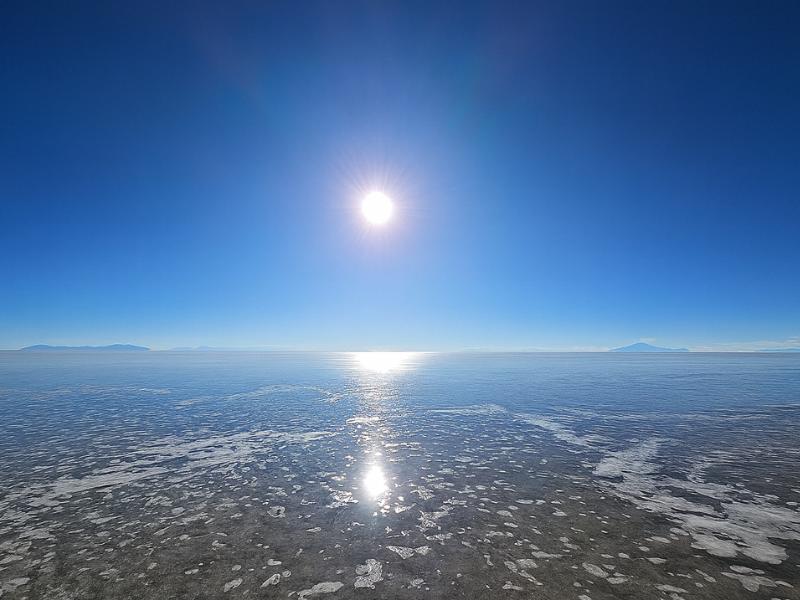
Colchani is the salt-mining cooperative village at the flat’s edge – the first real introduction to the salt economy that has shaped this corner of Bolivia. Salt is processed here in a small cooperative factory; the pyramid-shaped drying mounds on the flat’s perimeter are the cooperative’s production operation. There is a small museum, a souvenir market with textiles and salt handicrafts, and the point where the jeep drives off the road and onto the flat itself. That moment – when the white horizon appears in every direction simultaneously – is the first of several on this tour that stop conversation.
The perspective photo session happens somewhere on the flat where the surface is clean, the horizon is clear, and there is nothing in any direction to break the visual plain. The driver knows where to go. He will position subjects and suggest compositions; bring your own props if you have specific shots in mind. Toy dinosaurs, wine bottles, small figures – medium-sized objects work best for the scale illusions the flat makes possible. Budget time: this stop is often the most joyful of the three days and feels shorter than it is. Better operators don’t rush it.
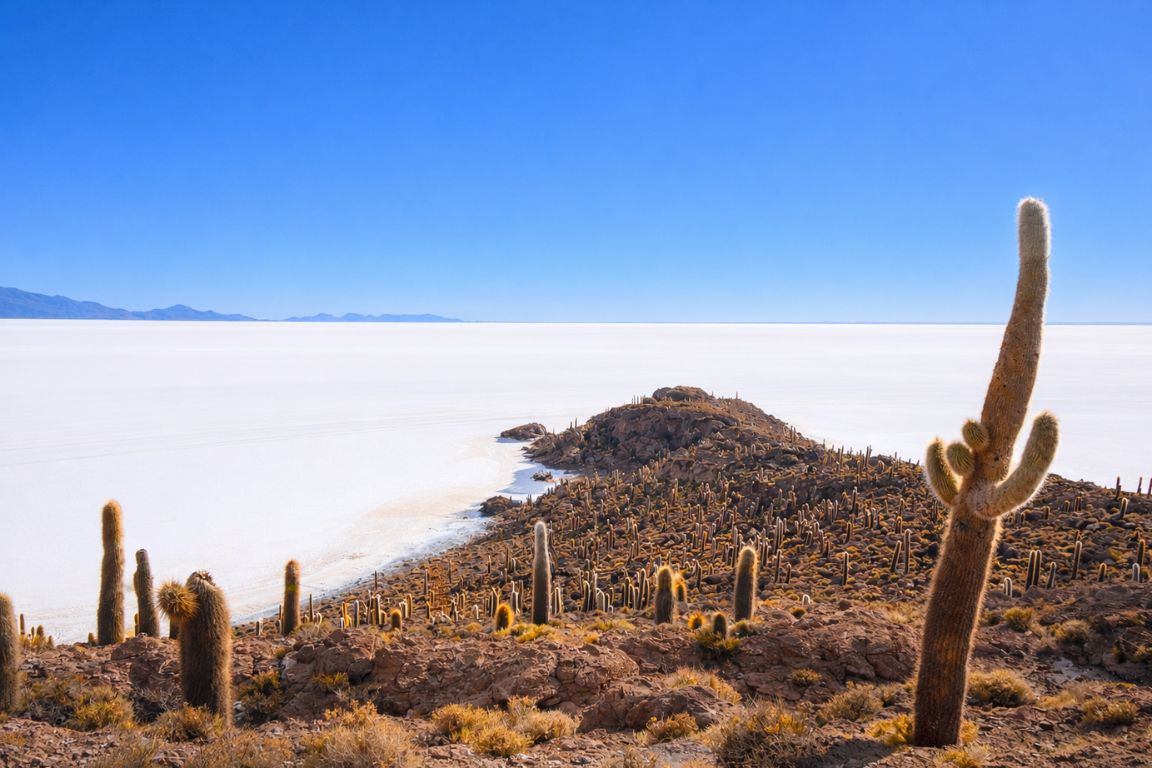
Isla Incahuasi – Cactus Island – rises as a dark mass on the horizon roughly 80 kilometers across the flat. A limestone formation that was once an actual island when a prehistoric lake covered this entire basin, it now rises from the salt covered in columnar cacti up to 10 meters tall and over 1,000 years old. Climbing the marked path to the summit takes 30 to 40 minutes and delivers a 360-degree panorama of the salt flat extending to every horizon. Entry costs 30 BOB (around $4 USD) paid at the gate – not included in the standard tour price. In wet season when the flat floods, the island becomes inaccessible.
Sunset on the flat closes day one. The driver positions the jeep facing west with a clear horizon. The cook or guide produces wine or local beer, snacks, and sometimes a full aperitivo table set directly on the salt. Light moves through the Altiplano’s clear atmosphere with unusual speed – the salt goes pink, then orange, then gold as the sun drops. In wet season, all of it reflects in the water below and doubles. Drive back to the salt hotel takes 30 to 45 minutes. Sleep early. Day two starts at 6:30am.
Not sure where to start? I’ve put together a complete guide on how to visit Salar de Uyuni tours so you understand tour operators, altitude preparation, and whether to enter from Bolivia or cross from Chile.
What Happens on Day Two of the Tour?
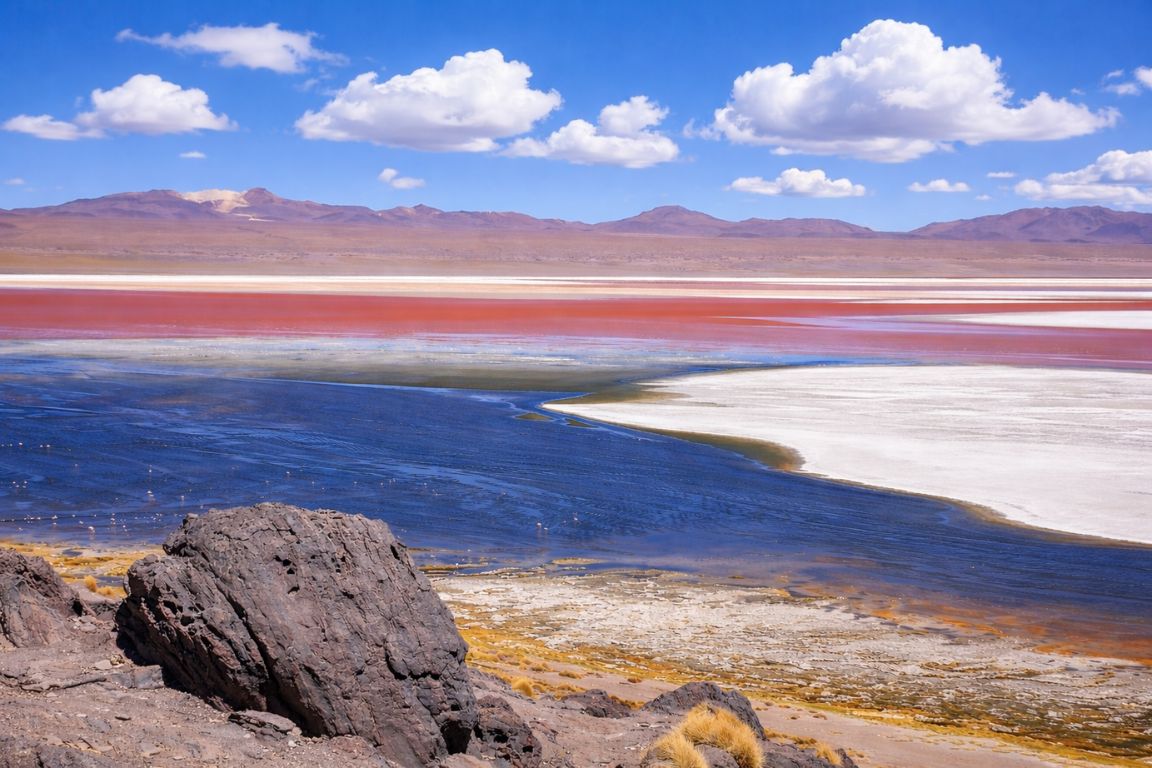
 Day two is the longest and most visually varied day of the circuit. The jeep leaves the salt hotel early and drives south through increasingly remote terrain, stopping at five high-altitude flamingo lagoons – Cañapa, Hedionda, Chiarkota, Honda, and Ramaditas – before crossing the Siloli Desert where the Árbol de Piedra stone tree stands, and ending at Laguna Colorada: a 60-square-kilometer lake of mineral-red water inhabited by over 40,000 flamingos of three species. Night two is a basic refugio near Laguna Colorada at approximately 4,300 meters – the most remote and most rustic sleep of the tour , and the night with the most remarkable sky.
The flamingo lagoon sequence across the altiplano is where most travelers first realize the 3-day tour contains something genuinely beyond the salt flat. Each lagoon reads differently – different mineral composition, different color temperature, different flamingo density, different volcanic backdrop. Laguna Cañapa is calm and blue-grey with flamingos feeding in the shallows. Laguna Hedionda (named for its sulphur smell) holds denser populations. The Ollagüe Volcano is visible from several stops, a semi-active peak with a thin plume of white smoke rising from its summit. The entire lagoon sequence plays out against an otherworldly landscape of volcanic rock, high-altitude desert scrub, and permanent snowcaps on peaks approaching 6,000 meters.
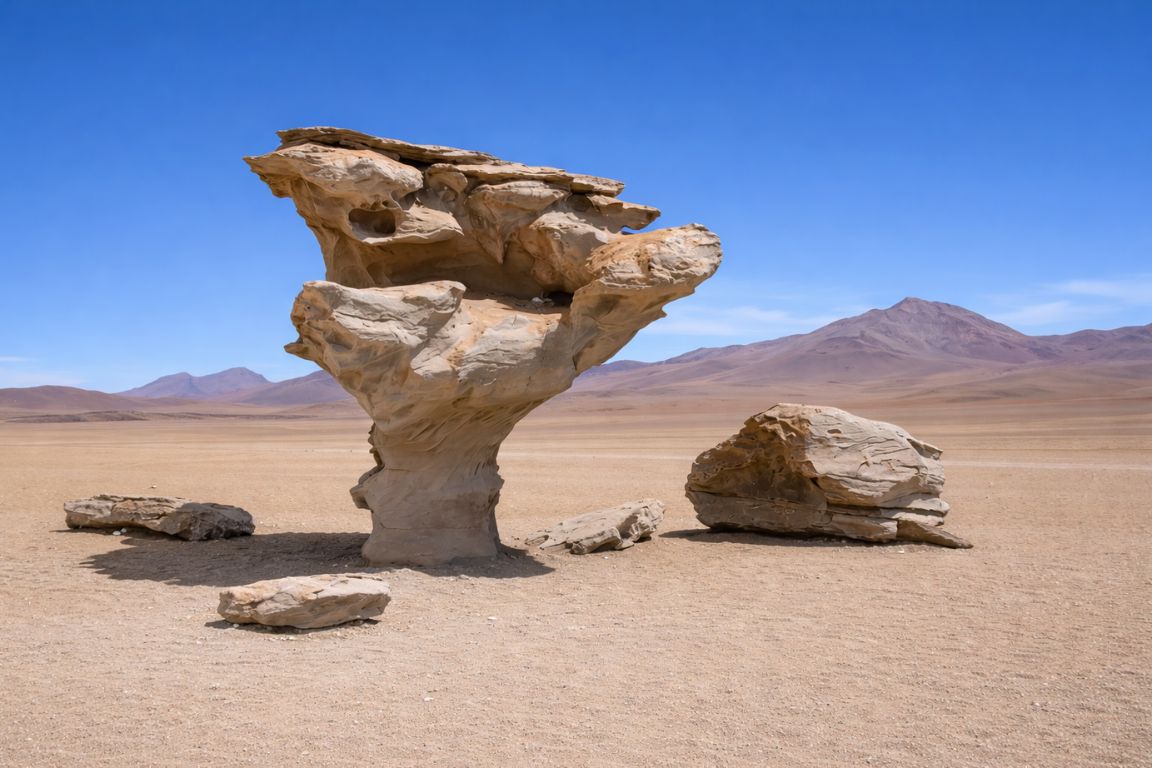
The Siloli Desert arrives after the lagoon sequence – a vast plateau at 4,500 meters where wind-sculpted rock formations emerge from the sand. The Árbol de Piedra, the Stone Tree, is the circuit’s most celebrated geological feature: a 7-meter volcanic rock formation shaped by centuries of 120km/h winds carrying abrasive sand, worn at its base to a narrow stem that makes the top-heavy structure look physically impossible. Viscachas – South America’s mountain chinchilla relative, a small rabbit-like creature with a long bushy tail – are almost always visible in the rocks around the formation. They’re surprisingly unbothered by people and excellent for photographs.
Laguna Colorada is the emotional peak of day two. The lake’s water is a deep mineral red caused by algae (Arthrospira) and plankton thriving in its saline composition. White borax deposits line the shoreline in geometric crystalline patterns. Three species of flamingo feed here – the Chilean, Andean, and James’s. The James’s flamingo, once thought extinct until rediscovered in 1956, breeds only at this lake and a handful of similar high-altitude sites. The Eduardo Avaroa Reserve entrance fee is collected at a checkpoint on the approach: 150 BOB for foreigners (around $22 USD), not included in most standard tour prices. Carry Bolivianos cash.
Night two at the refugio near Laguna Colorada is honestly basic. Simple concrete or stone structures with bunk rooms, shared bathrooms, and heating that amounts to whatever diesel stove is available. Electricity typically runs for a few hours in the evening only. Temperature at 4,300 meters in the Bolivian winter drops well below zero. Bring the sleeping bag liner. Bring the headlamp. Bring enough warm layers to maintain body temperature without relying on the building’s heating. What the refugio lacks in comfort it compensates for in sky – the Milky Way from 4,300 meters with little light pollution away from settlements is something that stays with people long after the tour ends.
Curious about capturing the flats? Here’s our complete Salar de Uyuni tours photography guide – camera settings, timing for the best light, props for perspective tricks, and how to shoot the mirror effect properly.
What Happens on Day Three of the Tour?
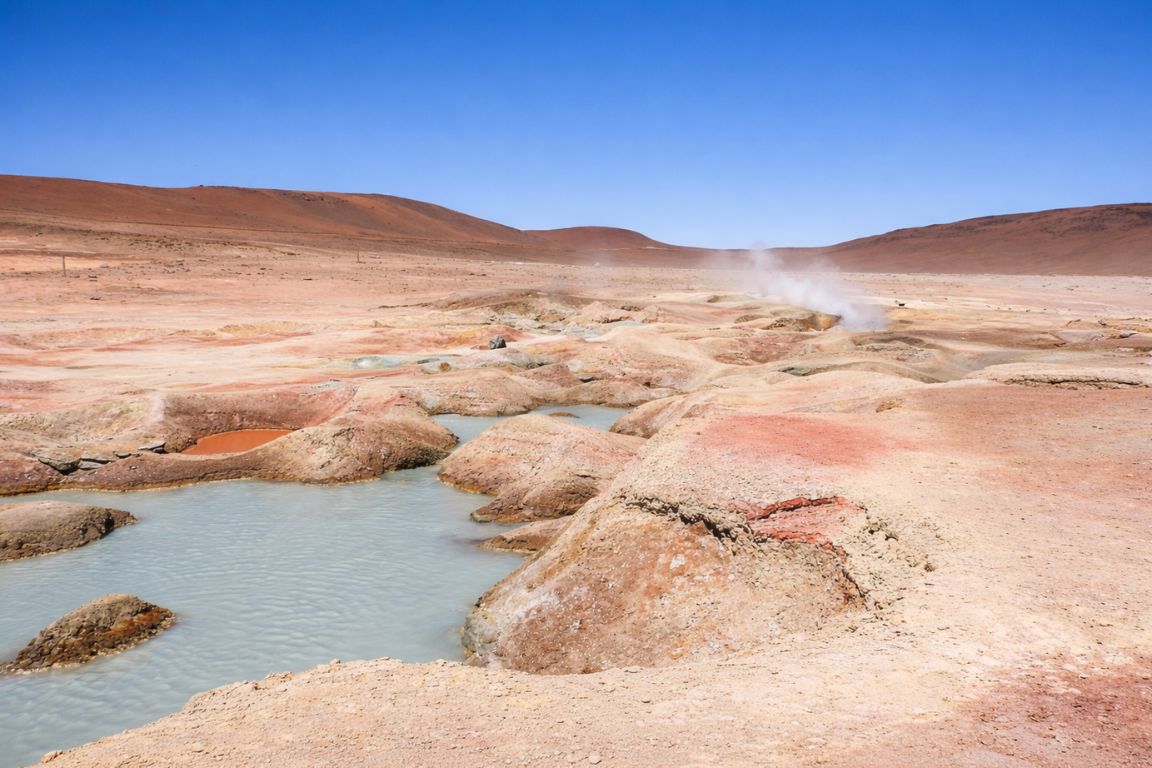
 Day three begins at 5:00am – earlier than any other day, by design. The Sol de Mañana geyser field is most active in the early morning when the temperature differential between superheated ground and cold air is greatest. By 6:00am the group is standing at 5,000 meters on the edge of a field of boiling mud pots, sulphur vents, and steam columns rising 20 meters into thin air. From there the day descends gradually: Polques hot springs for a warmth-restoring soak, the Salvador Dalí Desert, Laguna Verde and Laguna Blanca at the foot of Licancabur Volcano, and either a return drive to Uyuni or a border crossing into Chile.
Sol de Mañana is the highest point of the tour and the most physically demanding stop. Walking from the jeep to the geyser vents – 50 to 100 meters on rocky, uneven ground – produces breathlessness in almost everyone regardless of fitness. The ground around the mud pots is unstable at the edges; the guide marks the safe walking zones. Vents produce steam from water heated to 80 to 90 degrees Celsius. Mud pots bubble and pop at the surface. The smell of sulphur is strong. The sound is a constant low boiling punctuated by occasional pressure releases. The cold at 5,000 meters is sharp. Dress completely before you open the door – jacket, gloves, hat – and then step out.
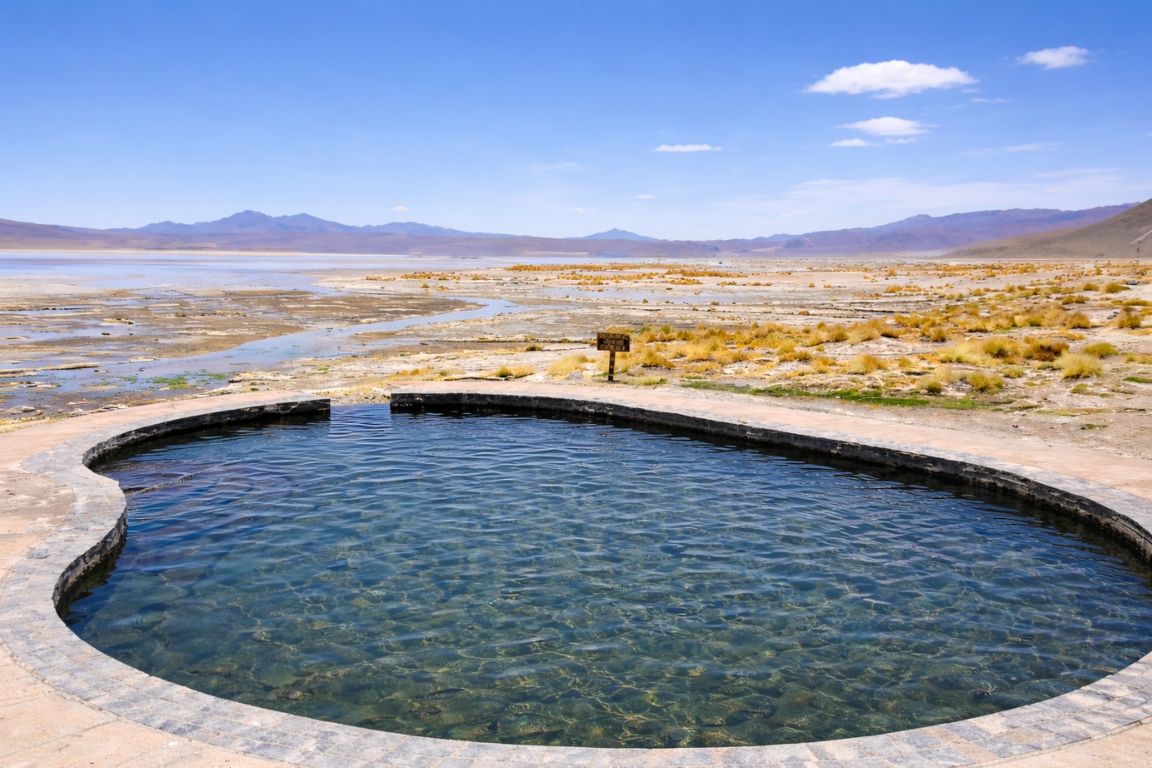
The Polques hot springs arrive as a welcome contrast. A natural thermal pool at roughly 30°C, small enough to hold 10 to 15 people at once, set at the edge of a lagoon with flamingos visible in the background. Entry costs 6 BOB (around $1 USD). Bring a swimsuit and a towel – neither is provided on standard tours. Arriving early at Polques, before other groups from the night-two refugios, means having the pool without a queue. A soak here after a 5:00am start in minus-temperature air is one of the tour’s genuine pleasures.
The Salvador Dalí Desert is named by guides who noticed its resemblance to the surrealist painter’s landscapes, and who weren’t wrong. A section of the altiplano where red, orange, yellow, and brown volcanic rock formations emerge from windswept sand, the colors coming from different mineral content in different rock layers. The effect in morning light, with a clear Altiplano sky and no competing features on the horizon, is visually unlike anything in temperate or tropical landscapes. The drive continues through this terrain for several kilometers.
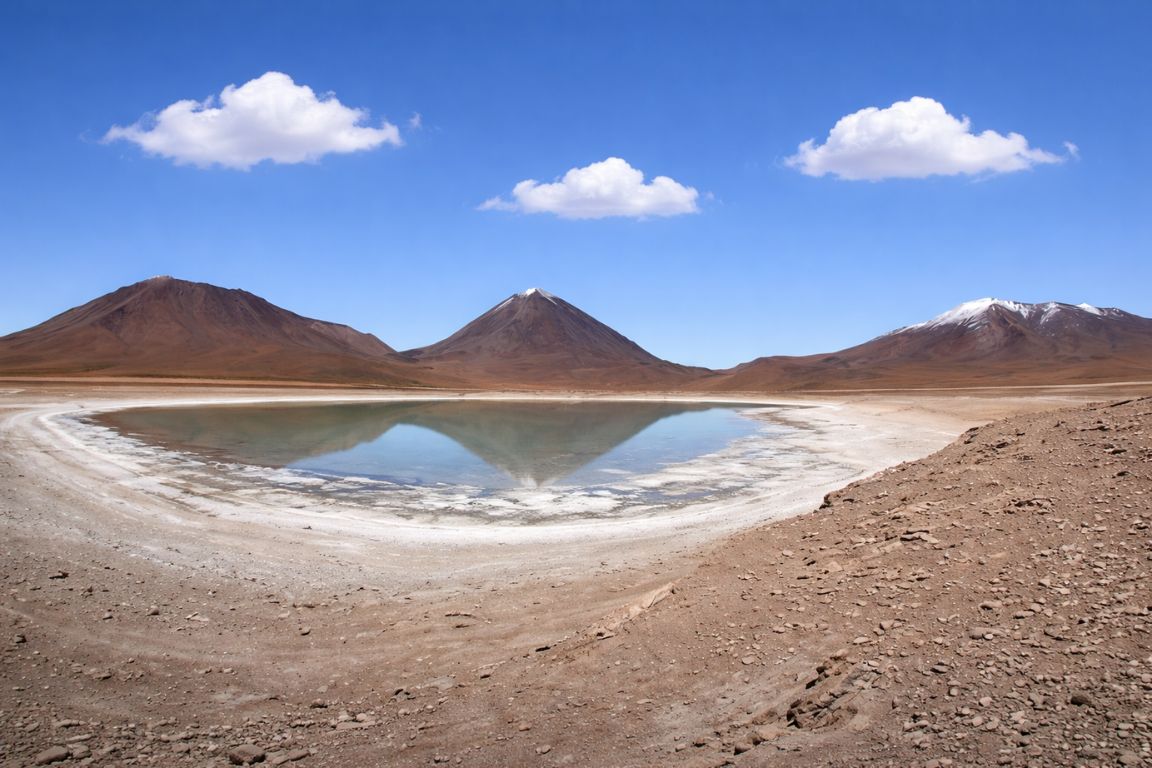
Laguna Verde sits at the foot of Licancabur Volcano at 5,916 meters, on the Bolivia-Chile border. The lake’s extraordinary green-turquoise color comes from copper, lead, arsenic, and other mineral concentrations in its highly saline water. The color is wind-dependent: on calm days it reads brilliant emerald; on windy days the minerals suspend differently and the hue shifts toward a murkier grey-green. The backdrop of Licancabur’s perfect volcanic cone is one of the most photographed compositions in Bolivia. Laguna Blanca, immediately adjacent, is a pale cream-white by comparison – the two together produce a color contrast that looks digitally altered in photographs but is entirely real.
The tour ends with either a return drive to Uyuni (arriving around 5:00 to 6:00pm) or a crossing into Chile at the Hito Cajón border post and a transfer to San Pedro de Atacama (roughly two hours from the border). Travelers crossing to Chile should have passport and entry documentation ready – the border post is a basic installation in remote terrain and not the place to discover a paperwork problem. The Chile transfer is usually an additional cost of $10 to $20 USD per person beyond the base tour price; confirm this at booking.
What Should You Pack for a 3-Day Uyuni Tour?
 Pack for temperature extremes in both directions. Midday on the salt flat can reach 20°C under intense UV radiation. Night two at the refugio near Laguna Colorada can drop to -15°C. The packing list falls into four categories: temperature management (thermal layers, windproof outer layer, gloves, hat), sun protection (UV-rated sunglasses, SPF50+ sunscreen reapplied every two hours, lip balm with SPF), overnight comfort items (sleeping bag liner, headlamp, toilet paper, hand sanitizer), and cash in Bolivianos for the entrance fees and bathroom charges that are not included in the tour price .
The sleeping bag liner is the item most travelers wish they had when they didn’t bring it. Night two at the refugio near Laguna Colorada at 4,300 meters is cold enough that the blanket typically provided is insufficient for most people arriving from sea level or temperate climates. Some operators rent sleeping bags for around 50 BOB per night – confirm when booking. Bringing your own liner adds almost nothing to your pack weight and can add comfort, but is not a substitute for a sleeping bag rated for the expected temperature.
The UV situation on the salt flat is more severe than any standard “bring sunscreen” travel advice conveys. At 3,656 meters, the thin Altiplano atmosphere filters less UV than at lower altitudes. The white salt reflects UV back upward – so you’re receiving radiation from above and below simultaneously. UV-rated sunglasses are not optional comfort. People have suffered temporary vision loss walking the flat with cheap non-UV glasses. Factor 50 minimum, applied before getting in the jeep and reapplied at every stop. Lip balm matters because the dry air at altitude burns lips fast.
| Temperature | Thermal base layers (top and bottom) | Merino wool or synthetic – not cotton; for cold mornings and nights |
| Mid-layer fleece | For layering down on the warmer salt flat afternoons | |
| Windproof outer layer | Essential for the day-three geyser stop – wind amplifies cold severely at 5,000m | |
| Gloves and wool hat | Non-negotiable for the 5:00am geyser departure | |
| Sun protection | UV400 sunglasses | Not fashion sunglasses – salt reflects UV upward; temporary blindness is documented |
| SPF 50+ sunscreen | Reapply every 2 hours on the flat; bring more than you think you need | |
| Lip balm with SPF | Altitude dry air burns lips quickly | |
| Overnight comfort | Sleeping bag liner | Night 2 at ~4,300m can drop to -15°C – the single most missed item |
| Headlamp | Power cuts common on night 2; day-3 departure is in complete darkness | |
| Toilet paper | Not reliably provided at stops from day 2 onward | |
| Hand sanitizer | Water access is limited across the entire circuit | |
| Swimsuit and towel | For Polques hot springs on day 3 – not provided on standard tours | |
| Cash (Bolivianos) | Isla Incahuasi entry | 30 BOB (~$4 USD) – not included in most tour prices |
| Eduardo Avaroa Reserve entry | 150 BOB (~$22 USD) foreigners – not included in most tour prices | |
| Bathroom charges and Polques | ~6 BOB per bathroom use from day 2; Polques entry 6 BOB |
Keep your daypack in the jeep cabin with everything you need during the day – sunscreen, medications, camera gear, water, snacks, and the swimsuit for Polques. Main luggage is strapped to the roof of the Land Cruiser under a waterproof cover. You cannot retrieve it easily between stops. Pack a small overnight bag with your sleeping liner, headlamp, toothbrush, and an extra warm layer to go in the cabin with you; the main bag stays on the roof until you reach the night’s accommodation. There are no shops, ATMs, or pharmacies anywhere on the circuit once you leave Uyuni.
Wondering about clothing? Check out our guide on what to wear in Salar de Uyuni tours – layering is critical when you’re dealing with extreme temperature swings and intense altitude sun.
How Do You Choose the Right Operator for a 3-Day Tour?
The single most important variable in tour quality is the vehicle and driver – not the branding, not the website, not the price. A well-maintained Land Cruiser with an experienced driver who knows the route is the foundation of a good experience. A poorly maintained vehicle on rough desert roads for three days is the foundation of a bad one. Ask to see the specific vehicle before committing, confirm whether oxygen is carried on board, and clarify exactly what is included in the price versus charged as extras on the circuit.
Budget range for the 3-day shared group tour runs from roughly $150 USD per person at the cheapest end to $280 USD for better-equipped group tours, and higher for private bookings. The difference between $150 and $200 typically buys a better-maintained vehicle, a guide with more than minimal English, and cleaner accommodation. The difference between $200 and $280 often adds a private room on night one at a proper salt hotel versus a basic shared hostel. Going below $150 USD for this circuit raises legitimate questions about vehicle maintenance and what is being cut. The terrain is too remote for cost-cutting on safety items to be acceptable.
Ask to see the vehicle before you hand over money. Good operators show theirs readily. Check tires visually. Bounce a corner of the vehicle – blown shocks produce alarming vibration across rough desert roads for 10 hours a day, three days in a row. Check whether a first aid kit is visible. Ask whether the vehicle carries supplemental oxygen. Better operators carry an oxygen cylinder as standard equipment on a route that reaches 5,000 meters. This is basic safety preparation, not a luxury feature, and operators who carry it will say so immediately. Operators who look blank at the question are telling you something.
Specific questions worth asking before booking: How many passengers per vehicle? Standard is six plus driver – four to five is more comfortable across three days. Is an English-speaking guide included or just a Spanish-speaking driver? Does the price include the Eduardo Avaroa Reserve entrance fee (150 BOB foreigners) and Isla Incahuasi (30 BOB)? Many tours list these as extra. What is the accommodation on night two – dormitory bunk room or private room option? What is the cancellation policy and what happens if a road floods? And can the tour end at the Chilean border rather than returning to Uyuni?
Booking in person in Uyuni – walking the main street near the plaza, visiting three to five agencies, asking questions and looking at vehicles – is how most travelers book and works well outside peak season. During July and August, checking dates ahead of time helps align the tour with your itinerary and lets you read recent TripAdvisor reviews at home with proper time. Be skeptical of any operator requiring large upfront deposits via wire transfer before you arrive in Uyuni – reputable operators collect payment at their physical offices in person.
If you want to skip researching dozens of operators, here’s our Salar de Uyuni tours comparison guide based on vehicle condition, guide knowledge, food quality, and what you actually get for different price points.
What Are the Most Common Mistakes on a 3-Day Uyuni Tour?
 The most common mistake on a 3-day Uyuni tour is arriving directly from sea level and starting the circuit the next morning without acclimatization. At Laguna Colorada on night two (4,300 meters) and at the Sol de Mañana geysers on day three (5,000 meters), travelers who skipped acclimatization often suffer hard enough that they can’t enjoy the stops fully. Spending 2 to 3 days at moderate altitude – Sucre at 2,750 meters or La Paz’s lower districts at about 3,200 meters – before Uyuni dramatically reduces altitude problems and is the single preparation decision with the highest return on the quality of the experience.
The second most common mistake is booking the cheapest tour without asking about the vehicle. At $150 USD for three days covering 1,000 kilometers in remote terrain, the economics of cutting costs land on vehicle maintenance, driver experience, and accommodation quality. A badly maintained jeep with blown suspension on rough desert roads for three days produces genuine physical discomfort and, in the worst cases, breakdowns in remote terrain with no assistance nearby. The difference between a $150 and a $200 tour is often not visible on an itinerary list – it becomes visible when the vehicle’s ride quality is compared, or when the driver navigates correctly the first time rather than the third.
Not bringing a sleeping bag liner for night two is the third most common regret. Almost every traveler who didn’t bring one mentions it. The refugio near Laguna Colorada at 4,300 meters is cold at night, the blankets are basic, and the combination is genuinely uncomfortable without extra insulation. A liner weighs almost nothing and costs little. Pair this with not bringing a headlamp – night two often has limited electricity, the 5:00am day-three departure is in complete darkness, and navigating to the bathroom at 2:00am without a light at altitude in an unfamiliar building is an avoidable problem.
Underestimating the cash requirement for entrance fees is a practical mistake that creates stress. The Eduardo Avaroa Reserve fee (150 BOB for foreigners, around $22 USD) is collected at a checkpoint and is not included in most standard tour prices. Isla Incahuasi is 30 BOB at the gate. Bathroom stops along the circuit charge 1 to 6 BOB each. Polques hot springs cost 6 BOB. There are no ATMs anywhere on the circuit – none at the salt hotel, none near Laguna Colorada, none at the geyser field. Withdraw Bolivianos in Uyuni town before departure and carry more than you think you need.
Skipping the perspective photo session by not bringing props is a smaller mistake but a consistent one. Guides sometimes carry a few props – a bottle, a small figure – but these are shared across the group and the selection is limited. Travelers who bring something specific to their own situation – a toy from home, a personal object, a small figurine that means something to them – consistently produce better and more personal perspective photos than those working with whatever is in the guide’s bag. Buy toy dinosaurs in Uyuni town the night before if you haven’t brought anything.
If you’re concerned about the 3,600m elevation, here’s our Salar de Uyuni tours altitude and preparation guide so you understand acclimatization needs, medication options, and how altitude affects everyone differently.
Planning Takeaways For Your Trip
Choose the itinerary around the experience you want, the time you have and the actual services included. Check the guide language, transport, overnight arrangements and extra costs on the selected listing.
Frequently Asked Questions
What time does the 3-day Uyuni tour start each day?
Day one departs 10:00 to 10:30am from Uyuni town. Day two departs 6:30 to 7:00am from the salt hotel. Day three departs at 5:00am to reach Sol de Mañana geysers at first light – the only stop on the tour where the exact timing genuinely changes what you see.
What entrance fees are not included in the standard tour price?
Isla Incahuasi on day one: 30 BOB (around $4 USD). Eduardo Avaroa Andean Fauna National Reserve entry on day two: 150 BOB (around $22 USD) for foreign visitors. Polques hot springs on day three: 6 BOB. Bathroom charges along the circuit from day two onward are typically 1 to 6 BOB per use. There are no ATMs on the circuit – bring all cash from Uyuni.
Can the tour end in San Pedro de Atacama instead of returning to Uyuni?
Yes. Most operators offer this as a standard variant at an additional cost of roughly $10 to $20 USD per person for the Chile border transfer. The itinerary is identical – you simply continue past Laguna Verde and cross at Hito Cajón into Chile, then transfer to San Pedro de Atacama. Confirm border-crossing documentation requirements before departure; the remote border post is not the place to discover a paperwork issue.
What is the accommodation like on night two of the tour?
A basic refugio near Laguna Colorada at approximately 4,300 meters. Simple bunk rooms, shared bathrooms, limited electricity (often only a few hours in the evening), and minimal heating. Temperature outside can drop to -15°C in winter months. Bring a sleeping bag liner and a headlamp. Many operators offer a private room upgrade for around $30 to $35 USD extra per person – worth it for travelers who find dormitory sleeping difficult, particularly on a night this cold at this altitude.
How many people are in a shared 3-day tour jeep?
Standard shared group tours seat six passengers plus the driver in a 7-seat Toyota Land Cruiser. Four to five passengers is noticeably more comfortable for three days of extended jeep travel. Private tours give your group the entire vehicle. Ask specifically when booking – some budget tours fill to seven passengers, which is genuinely uncomfortable for long drives across rough terrain.
Is the 3-day tour physically demanding?
Not in the conventional sense – it is not a trekking or climbing tour. The vast majority of time is spent in the jeep. Short walks at each stop on flat or gently sloping terrain are the main physical demand. The real challenge is altitude: the circuit reaches 5,000 meters at Sol de Mañana on day three, and night-two accommodation sits at 4,300 meters. Acclimatizing for 2 to 3 days at moderate altitude before starting is the most effective preparation and makes a measurable difference in how the circuit feels.
Choose Your Uyuni Experience
Choose the itinerary that fits, then check your travel date before arranging onward transport or separate rooms.
Initial editorial recommendation. No preferences have been entered.
Salt Flats And Colored Lagoons
Combine the salt flats with colored lagoons, meals and an English-speaking driver-guide.
Lodging descriptions conflict on private bathrooms; confirm both nights. Park fees and the optional Chile transfer cost extra.Scheduled dates load automatically. Availability and final price are confirmed on Viator.
No verified tour meets all of these preferences. Adjust the choices below or reset.
Compare Options And Tailor Your Choice
- Private Circuit With Hotel Lodging (3 days): A private salt-flat and lagoon circuit with an English guide, meals, park entries and hotel lodging. Palacio de Sal or Luna Salada and Tayka or similar hotels; confirm exact rooms. Chile transfer excluded. Prior acclimatization required.
- Three-Day Circuit With Basic Lodging (3 days): Visit the salt flats, colored lagoons, geysers and hot springs with meals and basic lodging. Choose the English-guide option. Cold basic rooms; sleeping bag included in winter or on request. Entries, water and Chile transfer extra. Not suitable for pregnancy, mobility impairments or pre-existing conditions.
- Salt Flats And Sunset Day Trip (9 hours): A full salt-flat day with lunch, an English-speaking guide and sunset. Rain boots included; Incahuasi entry costs extra. Colchani hotel pickup has a surcharge.
Compare Your Complete Quotes
Use the same currency for both totals, including transport, rooms, meals and fees for your whole party.
Affiliate links: we may earn a commission when you book, at no extra cost to you.