Best Time to Visit Salar de Uyuni for the Mirror Effect
The Uyuni mirror effect happens in the wet season (Dec-Apr), with peak chances in February. Learn the best time of day, how it works, and the one strategy that maximizes your chances of seeing it.
Choose time on the salt flats rather than tour length alone: a three-day lagoon circuit is not three days of mirror photography.
Last updated: September 9, 2026
The mirror effect happens when a thin layer of rainwater – between 2 and 20 centimeters – sits still on the salt flat’s surface. This only occurs during Bolivia’s wet season, from December to April. The peak window, confirmed by satellite data published in a 2025 scientific study, is late January through early March, with February offering the highest probability. Sunrise is almost always the best time of day – wind is minimal, the light is extraordinary, and the surface is at its stillest. The effect is real but not guaranteed on any specific date, which is why building extra days into your schedule is the single most reliable strategy for seeing it.
The two-day salt-flat itinerary offers more salar time with a hostel night and sunset; reflections still depend on water and wind. Check Two-Day Salt-Flat Dates
Mirror Effect at a Glance
| When it occurs | December to April (wet season only) |
| Peak window | Late January to early March – confirmed by Sentinel-3 satellite data |
| Best single month | January to March are commonly favored; conditions vary |
| Required water depth | 2 to 20 centimeters – shallower evaporates unevenly, deeper ripples in wind |
| Best time of day | Sunrise – wind is minimal, light is warm, surface is stillest |
| Worst time of day | Mid to late afternoon – wind picks up and ripples the surface |
| Guaranteed? | No, conditions can shift overnight in either direction |
| Can wind ruin it? | Yes at higher speeds but research shows thin water resists rippling better than expected |
| Best strategy | Build 3-4 nights in Uyuni to allow multiple attempts |
What Exactly Creates the Mirror Effect at the Salar de Uyuni?
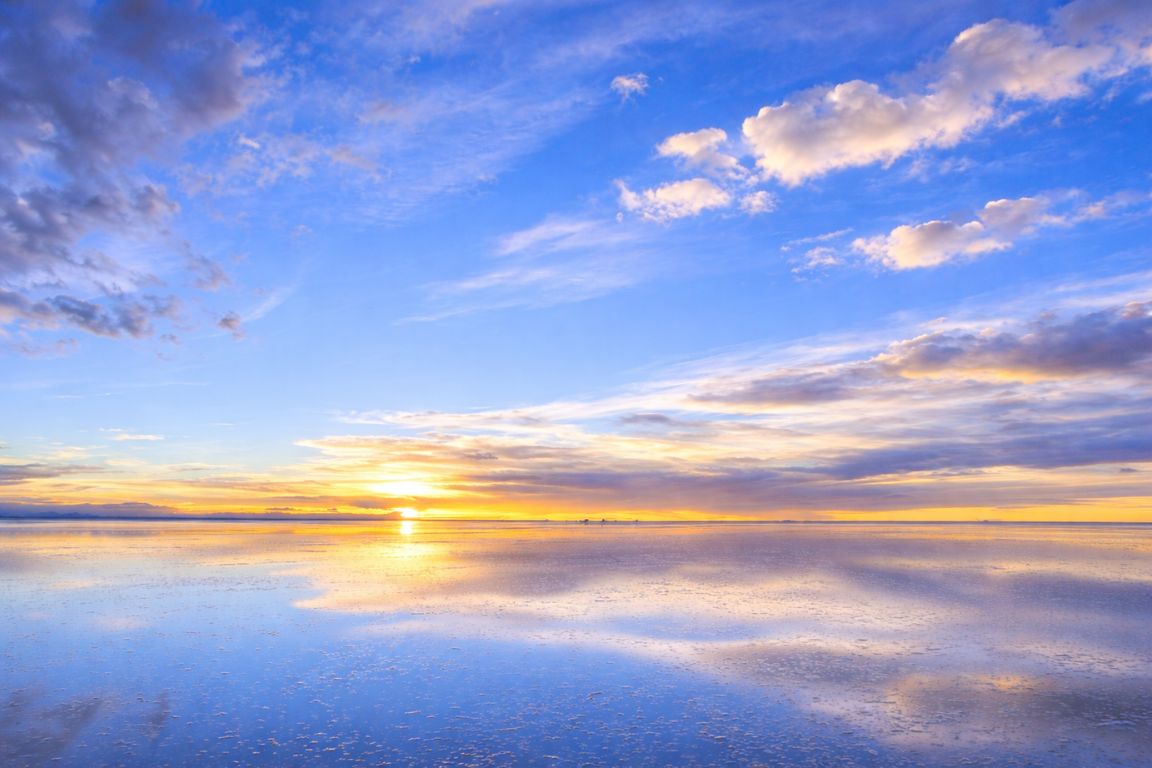 The mirror effect is the result of three things coinciding: a thin layer of rainwater sitting on the salt flat’s surface, a water depth between 2 and 20 centimeters, and calm enough conditions for the surface to become still. The Salar’s extraordinary flatness – the entire 10,582 square kilometers varies by less than one meter in elevation – allows water to spread uniformly across the surface rather than pooling in low points. The white salt beneath acts as a reflective base. When the water is still, the sky above is reproduced on the ground with near-perfect precision. The horizon disappears. Everything doubles.
The geology behind this is ancient. The Salar sits in a closed basin – a depression in the Andean Altiplano with no drainage outlet. Rainwater and meltwater from surrounding mountains flow in but have nowhere to go except evaporation. The salt flat itself formed when prehistoric Lake Minchin dried out roughly 30,000 to 42,000 years ago, leaving behind a thick crust of crystalline salt. That crust is what makes the flatness possible. Sediment and mineral deposits from subsequent lake cycles smoothed the surface so uniformly that NASA uses it to calibrate satellite altimeters – a surface function that requires near-perfect flatness.
A 2025 study in Communications Earth & Environment used Sentinel-3 radar observations to examine how surface smoothness varies across the salar and through time. Radar-smooth measurements are not the percentage of days a visitor will see photographic mirror conditions.
One finding from that same research surprised scientists and changes how travelers should think about wind. The shallow water depth – the scientists measured 1.8 centimeters on their February 2024 field visit – appears to inhibit wave formation even in breezy conditions. There may be a threshold wind speed below which waves simply cannot form in water this thin. This means mild wind may matter less than most travel guides suggest. What ruins the mirror is not a gentle breeze but sustained gusts, and those are most common in the afternoon. Morning calm is the key variable, not total wind absence.
Which Months Give You the Best Chance of Seeing the Mirror Effect?
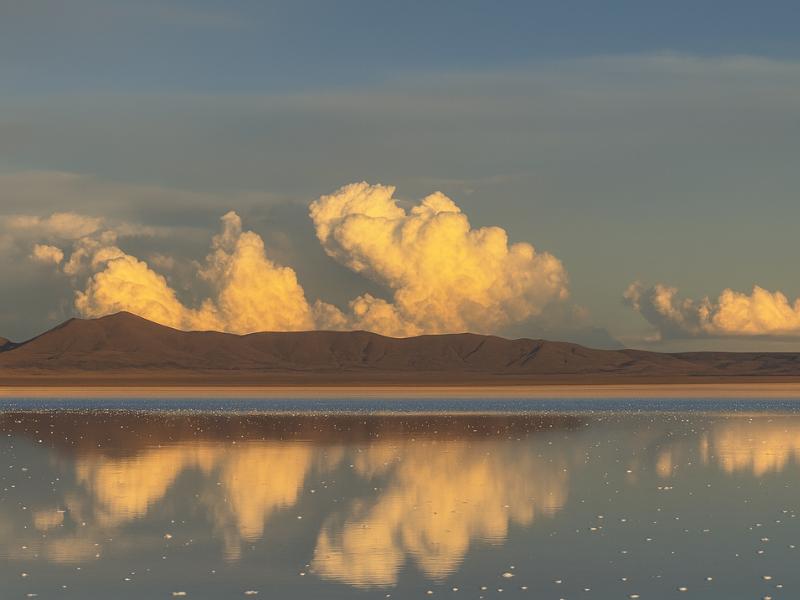
Reflections are more likely after wet-season rain, often from January through March. They require surface water and sufficiently calm conditions. Water can persist or unusual rain can occur outside the usual wet months; no month guarantees a mirror on your tour date.
Understanding the month-by-month picture matters for realistic planning. December starts the wet season but rainfall is still building and the surface may not yet have accumulated sufficient water for consistent mirror conditions. January is the rainiest month on record but creates its own problem: too much water, and the flat floods to depths that make vehicle navigation dangerous and tours cancelled. February strikes the balance most reliably – rainfall from prior weeks has built up the water layer, flooding is usually manageable, and the surface smoothness reaches its peak. The satellite data backs this up directly.
| November | Very low | Occasional early rains – partial reflections possible | Too little water for consistent conditions |
| December | Low to moderate | Wet season beginning – water building on surface | Conditions not yet at peak; holiday crowds |
| January | Moderate to high | Peak rainfall – water accumulation strongest | Flooding risk, tour cancellations, road closures |
| February | Commonly favored, without a guaranteed probability | Best balance of water depth and surface smoothness | Still some flooding risk; Incahuasi often inaccessible |
| March | Moderate | Rains tapering – residual water still present | Conditions variable as dry season approaches |
| April | Low – occasional | Late-season storms can still produce short windows | No guarantee; increasingly hit-or-miss |
| May-October | Zero | Dry season – flat is completely white and dry | No mirror effect possible |
March deserves more credit than it usually gets. Because the water from January’s rainfall doesn’t evaporate instantly – the high-altitude desert loses around 2 millimeters of water per day to evaporation – the flat often retains enough surface water in March to produce good reflections after a recent rain. Rainfall in March itself is lower, which means clearer skies and better light after a rainstorm.
April to May is the transition worth knowing about. While the odds of a full mirror are low, a good late rainstorm can produce conditions for a day or two. Travelers who come in late April primarily for the salt flat’s other offerings – the geometric salt patterns, milder temperatures, far lower crowds – sometimes get lucky with a mirror morning. It’s not something to plan around, but it’s not impossible either.
Timing completely changes what you see. The best time to visit Salar de Uyuni tours depends on whether you want the famous mirror effect from wet season flooding or the endless white expanse of dry season salt crust.
What Time of Day Is Best for Mirror Effect Photography?
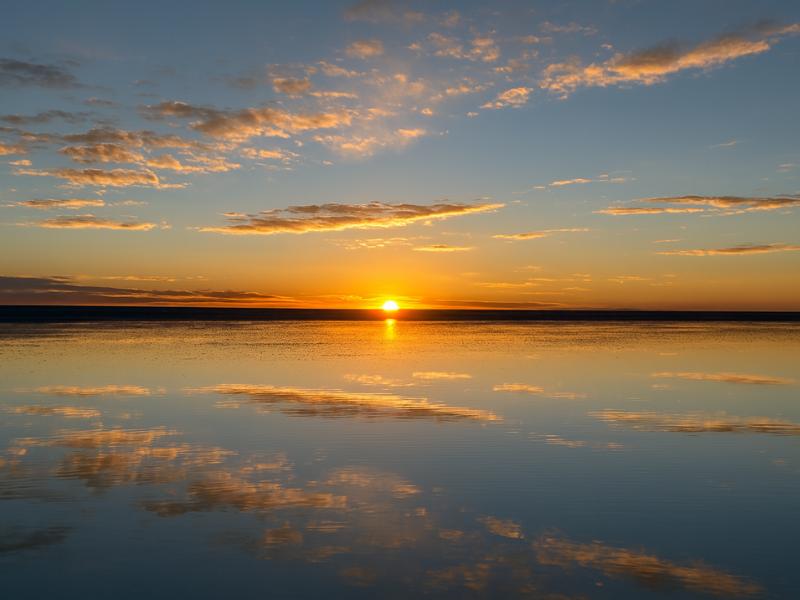
Sunrise is the best time, by a significant margin. Wind on the Salar de Uyuni is almost always stronger in the afternoon and evening than in the early morning. A surface that was perfectly still at 6am may be visibly rippled by 10am. Sunrise also brings the most dramatic light – the low angle turns the reflected sky pink and orange before it goes white, and for roughly 20 minutes the entire surface glows with colors that midday light cannot produce. Tours that get you on the flat by 5:30am consistently outperform tours that depart at 9am for mirror conditions.
The wind pattern on the Salar is nearly universal across wet season. Mornings are calm. The air is cold and still at dawn. By mid-morning, as the sun heats the surface, convection begins – warm air rises, cooler air moves in, and a breeze develops. By afternoon, especially in the summer months of the Southern Hemisphere, that breeze becomes something more. Sustained wind across a 10,000 square kilometer flat with nothing to break it builds quickly. By 2pm, what was a mirror at dawn is often a rippled surface that produces only blurred reflections.
Sunset is the second-best option. Wind often drops as the sun goes down and the surface begins to cool. The light is warm again. Some travelers find sunset reflections actually more dramatic than sunrise because the colors tend to be deeper – more orange, more red – against a surface that has had all day to accumulate subtle patterns. The trade-off is that you’ve already had a full day on the flat, and positioning for sunset means staying out until the light fades, which then requires navigating back to accommodation in the dark.
Midday on the Salar during wet season is the worst time for the mirror – not just because of wind, but because the overhead sun produces harsh white light with no color differentiation in the reflection. The surface looks bright but flat. Photos taken at noon during wet season often look less interesting than photos taken at 5am or 6pm. If your tour doesn’t include a sunrise start, ask the operator specifically to add one. A good operator will accommodate this without hesitation. An operator who won’t adjust timing for conditions is an operator worth reconsidering.
If you’re going for the photos, here’s our Salar de Uyuni tours photography guide so you understand camera settings for salt flat brightness, when to shoot for mirrors, and how to set up those forced perspective tricks.
What Can Ruin the Mirror Effect Even During Peak Season?
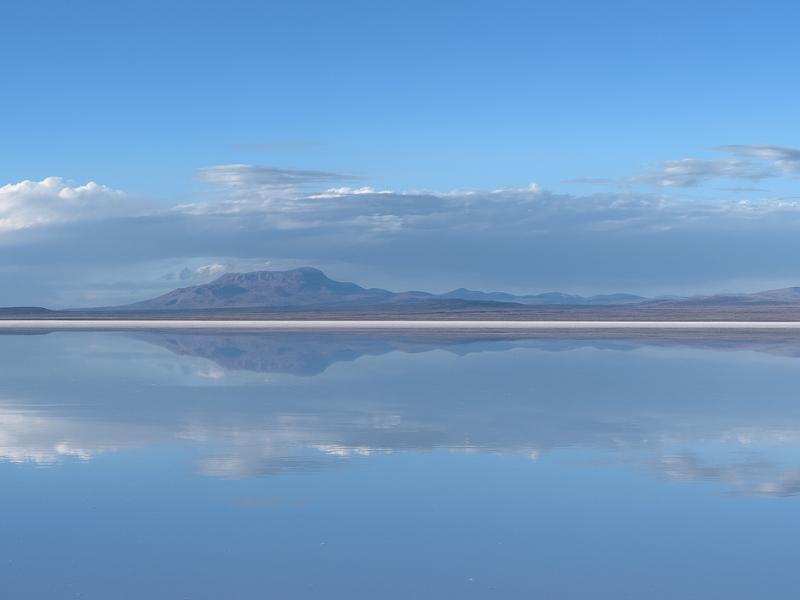
Four things consistently prevent mirror conditions even in the peak February window: too much water (the flat floods above 20 centimeters and the surface starts rippling in any wind), too little water (recent rain has evaporated and the next storm hasn’t arrived yet), sustained afternoon wind, and rain actively falling on the surface (the settling raindrops disrupt the water into tiny ripples that destroy reflectivity). The ideal conditions are: rain the night or day before, clear skies on the day, calm morning air, and a water layer of a few centimeters. None of these can be controlled. All of them can be waited for, if you have the time.
Too much water is a trap travelers don’t anticipate. January is the rainiest month, but the periods of heaviest January rainfall can push water depth well beyond the 20-centimeter threshold. At that depth, even a mild breeze creates ripples. The jeep tracks from previous vehicles create waves. The surface looks dramatic from photos but the reflections are blurry or absent. The same heavy water levels that make January photos difficult are what sometimes cancel tours entirely – operators pull back when vehicle travel becomes genuinely unsafe through deep water.
The evaporation rate matters more than most travelers know. At 3,656 meters, the thin dry Altiplano air strips moisture from the surface at around 2 millimeters per day. After a significant rain, you have a window. That window varies depending on how much rain fell, the temperature, and the wind. A proper soaking rain might leave viable mirror conditions for four or five days. A brief afternoon shower might produce conditions for one morning only. This is why local knowledge from your guide is more reliable than any forecast app – experienced operators know which parts of the flat hold water longest, which areas drain fastest, and which zones are protected from the prevailing wind direction.
Active rain on the day is a paradox. You need rain to create the mirror, but rain falling while you’re trying to photograph it ruins the surface. Each raindrop creates a small ripple as it hits – multiply that across the entire flat and you have thousands of simultaneous interference patterns. The mirror becomes an impressionist painting: beautiful in its own way, but not the clean reflection most people come for. The ideal sequence is: rain overnight, clear skies by dawn, still air at sunrise. That sequence happens reliably in February, occasionally in December and March, rarely in November and April.
How Do You Maximize Your Chances of Seeing It?
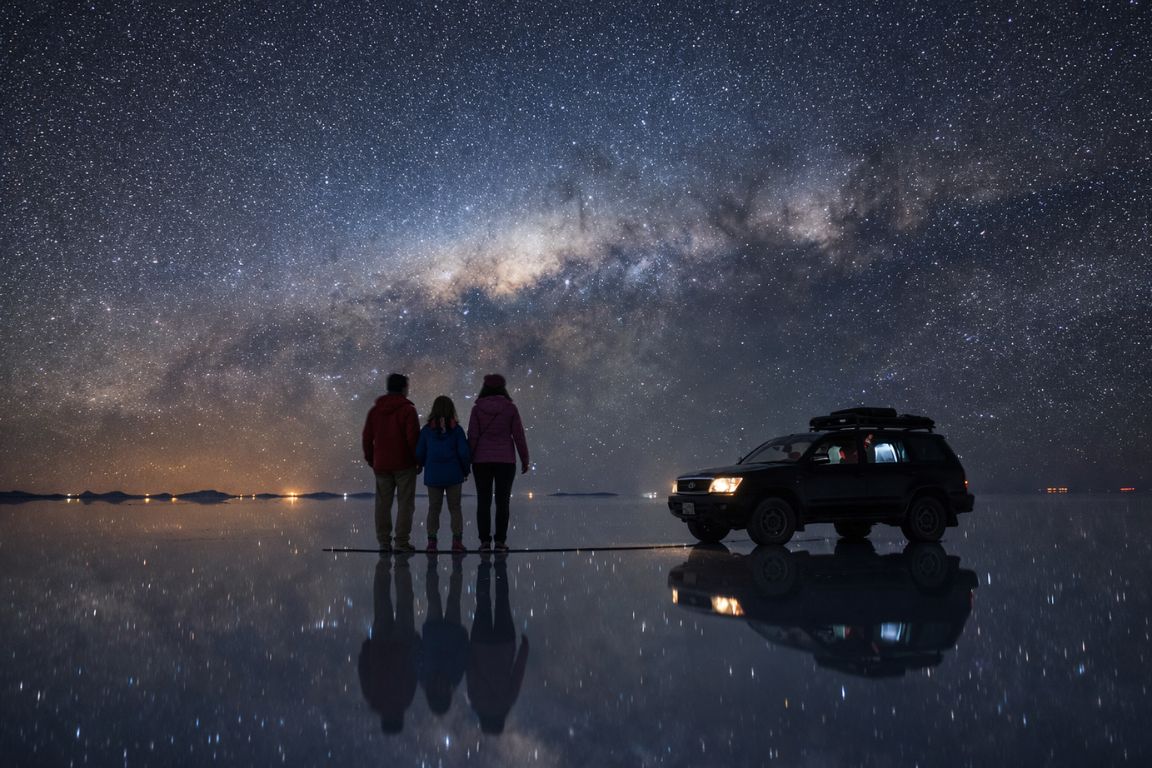 The single most effective strategy is to build more days into your schedule than you think you need. Travelers with three to four nights in Uyuni and access to multiple sunrise tours dramatically outperform travelers on a fixed two-night itinerary with one shot at conditions. Beyond timing, the other major variable is guide quality – an experienced local guide knows where on the flat the water is at the right depth, which zones are protected from wind, and when to move. No map, forecast, or algorithm replaces that knowledge.
Book a sunrise-specific tour on at least one morning of your stay, separate from your main multi-day tour if possible. Operators in Uyuni – Hodaka, Brisa Tours, and others who specialize in mirror conditions – run dedicated sunrise and sunset sessions specifically for photographers chasing the reflection. These run 3 to 4 hours, cost around $35-45 USD, and can be booked day-by-day based on conditions. The day-trip approach is actually more flexible for serious mirror hunters than committing to a fixed multi-day tour itinerary that may put you on the flat at the wrong time of day.
Salt hotel accommodation at Colchani changes the equation for sunrise timing. Staying at Palacio de Sal, Luna Salada, or similar properties means the flat is a short walk from your room. You can be standing in ankle-deep water at 5:30am without the one-hour jeep transfer from Uyuni town. In February, that extra hour can be the difference between catching the pink light of early sunrise on a still surface and arriving to find a light breeze already building ripples. If seeing the mirror is your primary goal for the trip, staying at a Colchani salt hotel on your flat-visit night is worth the premium.
Wondering about lodging options? Check out our guide on where to stay in Salar de Uyuni tours – the town is extremely basic but salt hotels offer unique (if cold) experiences on the flats themselves.
Talk to your operator the evening before your flat visit. Ask what the surface looked like that day – depth, clarity, any wind. Ask which part of the flat they plan to use. Ask whether they can adjust departure time to catch the calmest window. A good guide will have been out on the flat that afternoon scouting. They will know whether conditions are building or fading, and they can position the jeep in the zones where water depth is optimal. This conversation takes five minutes and changes what you experience the next morning.
If you’re willing to optimize completely, avoid the full moon. Star-reflection photography – the Milky Way doubled above and below you – requires the darkest possible sky. Planning your wet-season visit around the new moon gives you both the mirror and the stars. Two extraordinary phenomena in the same night.
Need help choosing? Here’s our Salar de Uyuni tours comparison guide covering which operators consistently deliver safe vehicles, knowledgeable guides, and edible food versus which ones are just cheap for dangerous reasons.
What Is the Mirror Effect Like in Reality vs What You See in Photos?
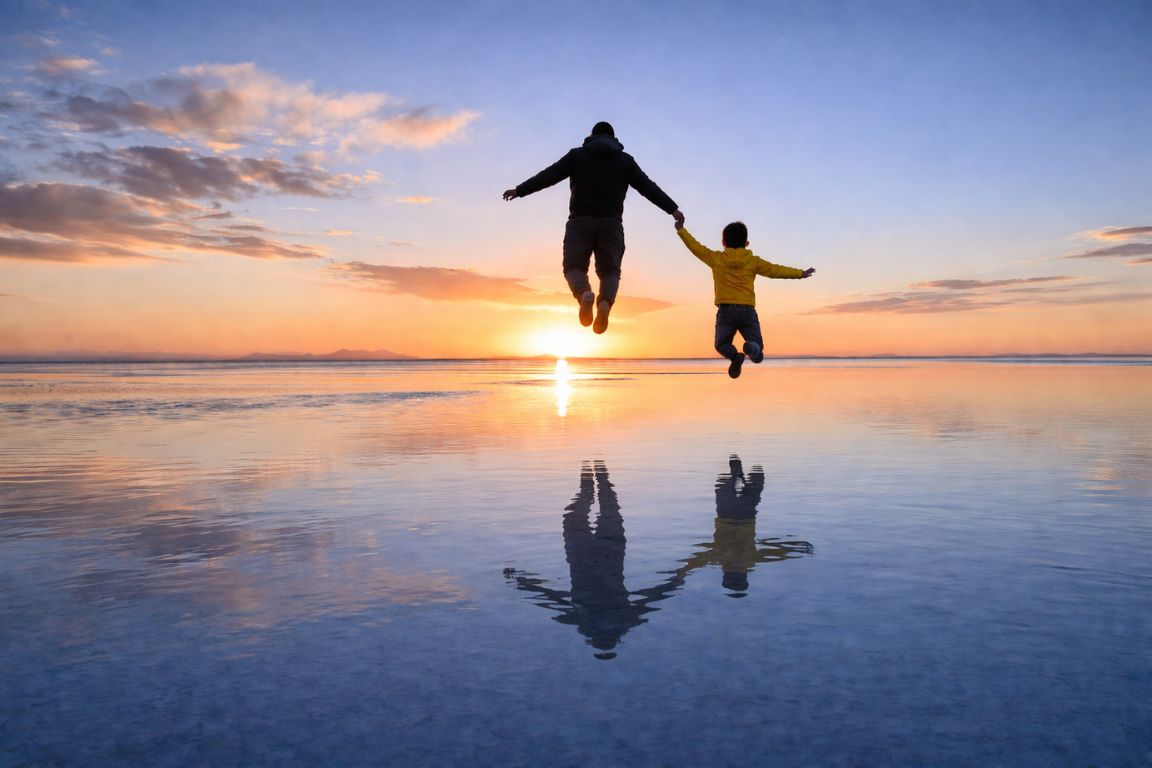 The photos are real. The mirror effect actually looks like that – the horizon genuinely disappears, sky and earth become indistinguishable, people standing on the surface appear to float. What the photos don’t convey is the physical reality around them: the cold at dawn, the absolute silence, the disorientation of standing in a white void with no visual reference for scale, the sound of shallow water moving against the salt crust. The experience is more sensory and stranger than any photo shows. Most travelers who see it describe the feeling as something closer to vertigo than beauty – a genuine unsettling of normal perception that photographs reduce to a pretty picture.
There’s also an honest caveat about uniformity. The 2025 satellite study confirmed what experienced guides have always known: the mirror doesn’t cover the entire flat uniformly at once. At any given time, some sections are glassy and still, others are mildly rippled, others may have too little or too much water. A good guide navigates to the best zone on that specific morning. The photos that look like an infinite mirror in every direction are real, but they’re taken from the right position at the right moment with skilled framing. The flat around them in those same photos may have less perfect conditions just 500 meters in a different direction.
The emotional impact is harder to predict than the visual. Some travelers are moved in ways they don’t expect. Others stand there, acknowledge that it’s extraordinary, and feel nothing particular. The experience depends on the day, on whether conditions are ideal or merely good, on whether you’ve had time to acclimatize and rest, on the quality of the company around you. Standing on the Salar at sunrise in February after a clear rainy night, with the sky perfectly doubled beneath your feet and nothing – no road, no landmark, no horizon – visible in any direction is a specific kind of experience. It doesn’t need enhancement. It just needs the right morning.
One thing almost everyone reports that photographs don’t capture: the sound. The salt crust underfoot makes a specific crunch that changes to a soft splash when water is present. Very shallow water over salt produces a sound like crinkled cellophane. Deeper water makes a low splash. In the stillest mornings, between your footsteps, you can hear nothing at all – just altitude and light and the reflection of clouds below your feet. That silence is part of what makes the place so disorienting. Photos can show you the visual. They can’t show you that.
What Should You Do If You Miss the Mirror Effect?
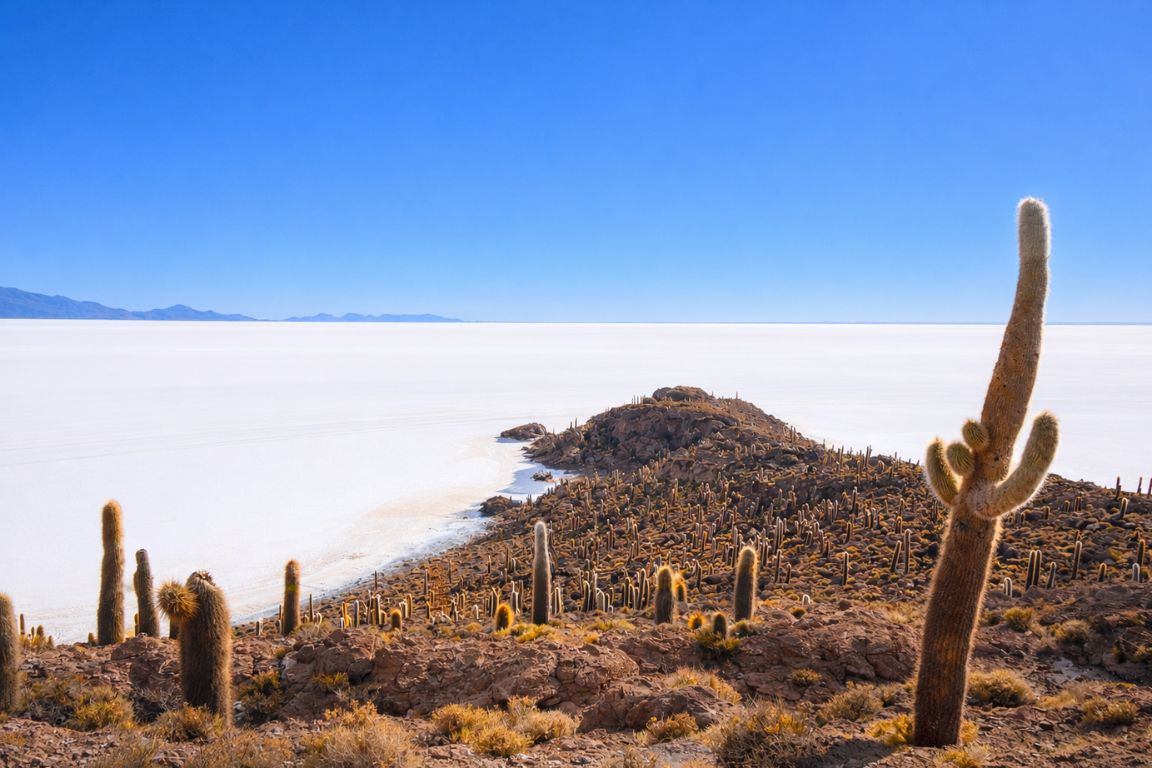 The dry-season Salar is not a consolation prize. The white hexagonal salt crust, the blinding sky, the perspective photography, the stargazing, the full access to Isla Incahuasi and the Eduardo Avaroa Reserve – these are genuinely extraordinary experiences that have nothing to do with the mirror. Travelers who visit in July or August and accept the flat for what it is in that season consistently leave satisfied. The ones who struggle are those who came specifically for the mirror, couldn’t get it, and couldn’t let go of that expectation. The Salar is worth visiting in any season. The mirror is worth chasing but it’s not the only reason to be there.
If you came specifically in wet season and the mirror didn’t cooperate, there are moves worth making before giving up. First: book a sunrise tour for the next morning. Conditions that were wrong today may have shifted by dawn. Second: ask your guide or operator what the forecast shows for the next 48 hours. A rainstorm tonight followed by a clear still morning tomorrow is the classic setup, and it happens. Third: consider whether you can extend by one or two days. In Uyuni town, accommodation is available without much advance notice in low season. The flat is accessible on short tours daily.
Partial mirror conditions are worth experiencing on their own terms. A slightly rippled surface that creates an impressionistic blur of sky and clouds rather than a crisp reflection is different from the canonical photos, but it has its own quality. Cloudy mirror conditions – when the sky itself is dramatic and that drama is doubled below – are often more interesting photographically than a clear blue reflection. A storm building on the horizon with the base of the clouds reflected in the water is something no sunny February morning produces. Managing expectations around what “counts” as the mirror effect will significantly affect your experience.
And if you simply didn’t get it at all: come back. The Salar de Uyuni in dry season is a completely different landscape worth a separate trip. Travelers who do both seasons describe them as genuinely distinct destinations that happen to occupy the same geography. That’s not a tour operator’s sales pitch – it’s what 13 years of watching people encounter this place has taught us. Both versions are extraordinary. The flat doesn’t owe you the mirror. But it gives you something extraordinary regardless.
Questions about current conditions, best timing for your specific dates, or how to structure a trip around maximizing mirror odds? Read the 3-day Uyuni tour guide for how those itineraries are put together.
Planning Takeaways For Your Trip
Choose the itinerary around the experience you want, the time you have and the actual services included. Check the guide language, transport, overnight arrangements and extra costs on the selected listing.
Frequently Asked Questions
Is the mirror effect visible every day during wet season?
Reflections are more likely after wet-season rain, often from January through March. They require surface water and sufficiently calm conditions. Water can persist or unusual rain can occur outside the usual wet months; no month guarantees a mirror on your tour date.
Can I see the mirror effect in April?
Occasionally. April is the tail end of wet season, and late storms can still produce mirror conditions for a morning or two after a rainstorm. The odds are significantly lower than February, and conditions are more unpredictable. April is worth trying if it fits your schedule, but don’t plan your trip around April specifically for the mirror.
Does wind always ruin the mirror effect?
Not always. Recent scientific research found that the extremely shallow water depth on the Salar – often less than 2 centimeters – inhibits wave formation even in mild wind. Stronger sustained gusts will still disrupt the surface, but a light breeze may have less impact than previously assumed. Morning wind is almost always calmer than afternoon wind, making sunrise the consistently best window.
What is the best month for the Salar de Uyuni mirror effect?
Reflections are more likely after wet-season rain, often from January through March. They require surface water and sufficiently calm conditions. Water can persist or unusual rain can occur outside the usual wet months; no month guarantees a mirror on your tour date.
Should I remove my polarizing filter to photograph the mirror?
Yes. A polarizing filter cuts reflections – exactly what you’re trying to capture. Remove it entirely for mirror shots. Use it in dry season to manage glare off the white salt crust. For wet season mirror photography, keep the filter off and instead focus on keeping the camera as low to the water surface as possible for the most dramatic reflection angle.
What happens if I visit during wet season but the mirror doesn’t appear?
Stay an extra night and book a sunrise tour the following morning. Conditions on the Salar can change dramatically within 12 to 24 hours – a rain event followed by calm, clear skies can produce perfect conditions from nothing. If that’s not possible, partial reflections and moody overcast conditions have their own photographic value. And the dry salt crust, the Eduardo Avaroa Reserve, and the stargazing are all extraordinary experiences in their own right.
Choose Your Uyuni Experience
Choose the itinerary that fits, then check your travel date before arranging onward transport or separate rooms.
Initial editorial recommendation. No preferences have been entered.
Two Days On The Salt Flats
An overnight salt-flat route with sunset, a hostel stay and an English-speaking driver-guide.
Park and museum fees, water and snacks cost extra. Mirror reflections depend on surface water.Scheduled dates load automatically. Availability and final price are confirmed on Viator.
No verified tour meets all of these preferences. Adjust the choices below or reset.
Compare Options And Tailor Your Choice
- Salt Flats And Sunset Day Trip (9 hours): A full salt-flat day with lunch, an English-speaking guide and sunset. Rain boots included; Incahuasi entry costs extra. Colchani hotel pickup has a surcharge.
- Private Starlight And Sunrise (4–5 hours): A private outing for the salt-flat night sky and sunrise, with hotel pickup and hot drinks. Confirm the departure time: the listing contains conflicting time details. Clear skies and reflections are not guaranteed.
- Sunset And Starlights (4 hours): Watch sunset and stay for the night sky on a four-hour outing from Uyuni. Choose the guide language when booking. Waterproof wellies are listed; skies and reflections depend on conditions. Age eligibility must be confirmed.
Compare Your Complete Quotes
Use the same currency for both totals, including transport, rooms, meals and fees for your whole party.
Affiliate links: we may earn a commission when you book, at no extra cost to you.