Salar de Uyuni Photography Guide
Salar de Uyuni is a photographer’s dream but each shot needs a different approach. Learn how to capture mirror reflections, forced perspective, and the Milky Way (and the mistake most people make).
Choose your light first: a daytime salt-flat circuit and a night-sky outing solve different photography goals.
Last updated: September 9, 2026
The Salar de Uyuni rewards photographers more than almost anywhere on earth but each shot type requires a completely different technique, timing, and sometimes different season. Forced-perspective shots work best in the dry season with the camera on the ground and medium-sized props. Mirror reflections require wet season, sunrise timing, no polarizing filter, and a guide who knows where the water depth is right. Milky Way photography needs a tripod, a fast wide lens, new moon phase, and either season. The single most common failure across all three types is the same: not getting low enough with the camera. Whatever you’re shooting here, get the camera closer to the surface than feels natural. Every time.
For perspective shots and sunset in one day, the guided salt-flat circuit includes lunch and an English-speaking guide. Check Uyuni Sunset Day-Trip Dates
Photography at the Salar de Uyuni: Quick Reference
| Forced perspective | Dry (May-Oct) | Mid-morning to early afternoon | Camera flat on the ground, medium-sized props |
| Mirror reflections | Wet (Dec-Apr) | Sunrise – wind is calmer | Remove polarizing filter, camera low to water surface |
| Landscape / hexagon patterns | Either | Golden hour (sunrise/sunset) | Wide-angle lens, low angle, graduated ND filter |
| Milky Way / night sky | Dry for stars, Wet for star reflections | New moon nights, 10pm-4am | Tripod, f/2.8 or faster, 20-30 sec exposure, ISO 1600-6400 |
| Sunset shadow lines | Dry | Late afternoon | Standing, group spread wide, sun behind camera |
| Storm drama | Wet | Approaching storms any time | Wide angle, emphasize scale against weather |
What Makes the Salar de Uyuni Unlike Any Other Photography Location on Earth?
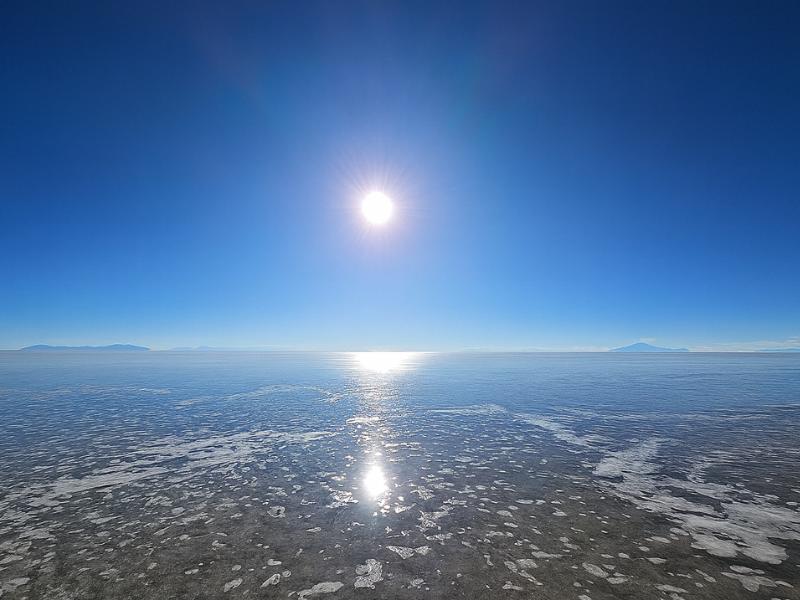
The Salar de Uyuni removes the two things that make photography difficult everywhere else: texture and reference points. The surface is so flat and uniform that normal rules of perspective collapse. Without visual cues telling the eye how far away something is, a small toy can look the size of a building. Without a horizon to anchor the image, sky and ground become interchangeable. No other location on earth produces these conditions at this scale, and because the flat covers over 10,000 square kilometers, you can work with them without crowds or competing backgrounds in the frame.
Most photography locations give you a beautiful scene to point your camera at. The Salar gives you something different: it gives you a physics problem to solve. The same rules that govern how cameras perceive depth still apply here, but the absence of competing visual information means those rules produce results that look impossible. A person 30 meters away appears to fit inside a Pringles can 30 centimeters from the lens. The sky doubles below your feet. The Milky Way appears to rise from the ground. None of this requires post-processing. It’s optics. The flat is just unusually well-suited to exploiting them.
There are three genuinely distinct visual experiences here, and most travelers only plan for one. Forced-perspective photography – the trick shots, the impossible scale photos – works best in the dry season when the white crust is unmarked and the horizon is crisp. Mirror photography works in the wet season, a completely different visual vocabulary. And astrophotography works year-round, but with the wet season adding the doubled-sky dimension that no other location offers. Planning around which of these you want, or building enough time to try all three, makes the difference between leaving with the photos you imagined and leaving with something better.
The light here is unlike anywhere else on earth. At 3,656 meters, with no atmospheric haze and a reflective white surface below, the UV is brutal and the color rendering is extraordinary. Golden hour at the Salar is not 20 minutes of soft light – it’s 45 minutes of rapidly shifting color that turns the white crust through pink, orange, and gold before the sun clears the mountains. The salt below reflects all of it back. Every landscape photographer who visits for the first time says the same thing: they didn’t expect the light to move so fast, or to be so good.
What Equipment Do You Actually Need to Photograph the Salt Flat?
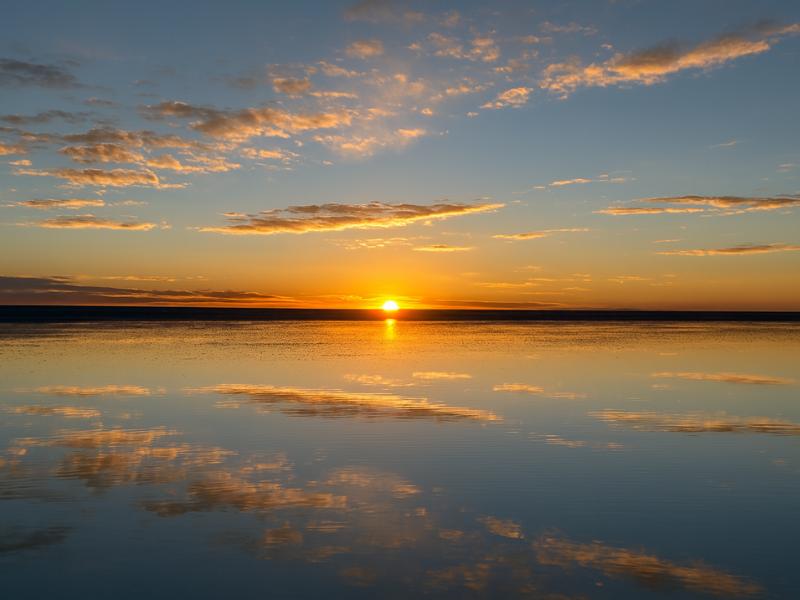
You don’t need professional equipment to leave the Salar with extraordinary photos. A smartphone with a wide lens and manual exposure control can produce remarkable results. That said, specific kit makes specific shots possible: a tripod is essential for Milky Way photography and very useful for mirror shots; a wide-angle lens (14-24mm) is the right focal length for the landscape; a fast prime (f/2.8 or wider) is needed for serious astrophotography; and a polarizing filter helps manage glare in the dry season but must be removed entirely for mirror shots. The most important item is something most photographers don’t pack: a mat or bag to lie flat on the salt surface.
The white surface creates an exposure challenge that catches almost every automatic camera off guard. The metering system sees a large area of bright white and underexposes it – the salt comes out grey, the blue sky comes out dark, and the photo looks flat. Shoot in RAW if your camera allows it. Use exposure compensation to push 1 to 2 stops brighter than what the meter suggests. The histogram is your friend here: look for the exposure to push the salt highlights close to but not into the right edge. If you’re shooting JPEG, the same principle applies – dial in positive exposure compensation and check regularly as the light changes.
White balance on the Salar is more variable than most photographers expect. In midday sun the salt reads close to daylight neutral. At sunrise and sunset, the warm light creates a genuine golden color that you’ll want to preserve – don’t let automatic white balance correct it away. Shoot RAW and set white balance in post, or set a fixed daylight or cloudy setting to lock in the color of the moment. Auto white balance tends to try to neutralize the golden tones of sunrise, which is exactly when those tones are most worth keeping.
| Tripod | Yes for night; very useful for mirror | Night exposures need 20-30 seconds; mirror shots benefit from perfect stability at water level |
| Wide-angle lens (14-24mm) | Strongly recommended | Captures scale; essential for Milky Way and landscape; works for perspective shots |
| Fast lens (f/2.8 or wider) | Essential for astrophotography | Allows short enough exposures to avoid star trails while still gathering light |
| Polarizing filter | Useful in dry season only | Reduces glare off white salt; must be removed entirely for mirror shots – kills the reflection |
| Graduated ND filter | Helpful | Balances bright sky with white salt in landscape shots |
| Remote shutter release | For night photography | Prevents camera shake during long exposures |
| Ground mat / camera bag | Yes | Lies under camera for ground-level shots; prevents salt from scratching lenses and bodies |
| Spare batteries (kept warm) | Yes | Cold at altitude drains batteries fast; keep spares inside your jacket |
| Sealed gear bags / Ziplocs | Yes | Salt is corrosive; dust crystals enter lens mounts, card slots, battery compartments |
| Microfiber cloths | Yes | Salt dust deposits on lenses constantly; wipe frequently |
| Props | For perspective shots | Toy dinosaurs, figures, bottles – medium-sized objects work best |
| Waterproof boots | Wet season only | You will wade through shallow water; salt water destroys unprotected shoes |
Salt protection for gear deserves emphasis. The Salar’s salt crystals are abrasive and get into everything. In wet season, salt water is actively corrosive. Camera bodies exposed to salt spray without cleaning routinely develop corrosion in ports and battery compartments within weeks. After every flat session, wipe down the body and lenses with a dry microfiber cloth. Never use wet wipes directly on lens glass. Keep the camera in a sealed bag between shooting sessions. If you’ve been wading with the camera at water level, clean every exposed surface before the salt dries.
Curious about stepping onto the flats? Here’s our complete breakdown of walking on the salt flats of Salar de Uyuni tours – what the surface feels like, how tours structure walking time, and when you can actually walk versus just photograph from the vehicle.
How Do You Shoot the Perfect Forced-Perspective Photo at the Salar de Uyuni?
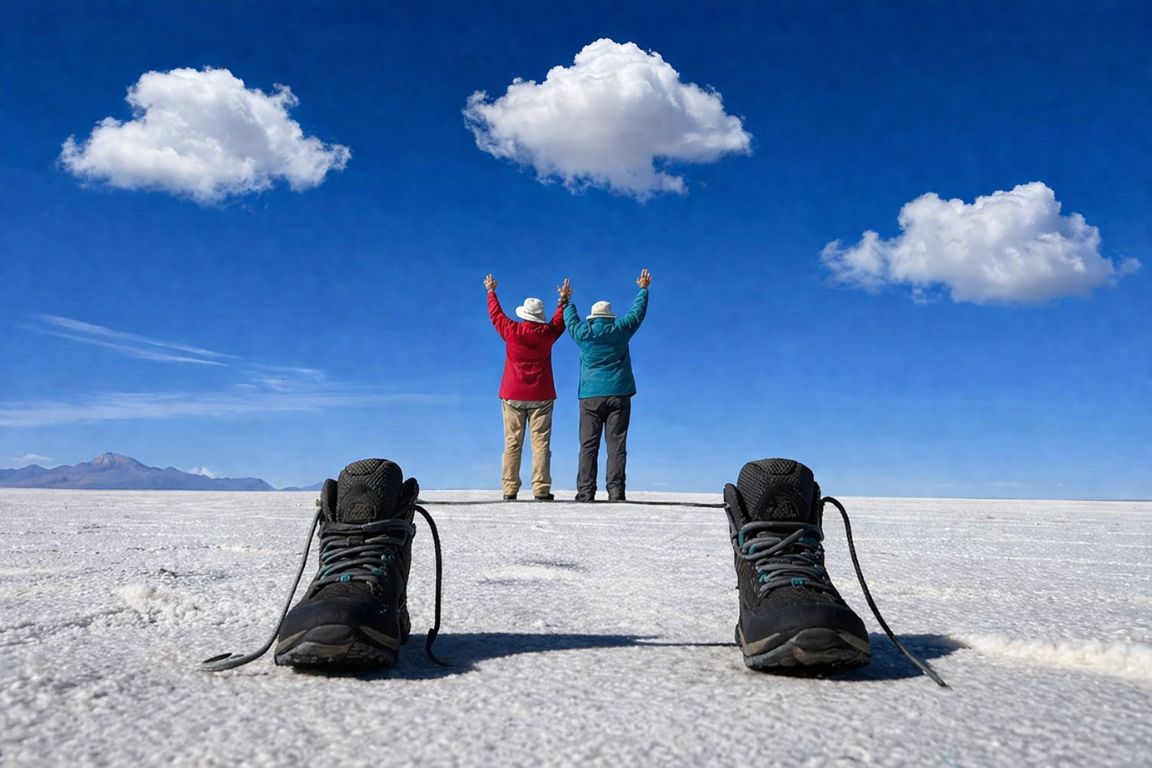 Forced-perspective photography at the Salar works because the flat white surface removes all depth cues – no shadows at the horizon, no texture gradient, nothing to tell the eye how far away anything is. The technique is specific: camera on the ground (not crouching, not at waist height – flat on your stomach), lens pointing at the prop in the foreground with the human subject positioned behind it at whatever distance makes the scale relationship work. The prop should be medium-sized, not tiny. The foreground object and background subject must appear to touch, with no visible gap of white salt between them.
The camera position is the single most important variable. Every beginner crouches or holds the camera at knee height and wonders why the photo doesn’t look like what they’ve seen on Instagram. The camera needs to be at surface level – as close to the salt as possible without resting on it. Lie flat on your stomach. Set the camera on the mat you brought. Use a flip screen or live view to compose without pressing your face to the viewfinder. That horizontal ground-level angle is what makes both objects appear on the same plane, which is what the illusion requires.
Prop selection is the second major variable. Very small props create a specific problem: the camera must get extremely close to them to make the scale work, which means the lens is trying to focus on something a few centimeters away while the human subject is 10 or 15 meters back. Depth of field becomes very narrow. Either the prop is sharp and the person is blurred, or vice versa. Medium-sized props – toy dinosaurs from Uyuni’s shops, a Pringles can, a wine bottle, a boot, the 4×4 itself – give both the camera and the lens more working room. Use f/8 to f/11 for maximum depth of field when shooting perspective shots. You’ll need enough shutter speed to keep it sharp handheld; if the light requires it, bump ISO rather than slow the shutter below 1/100s.
Shadows reveal the trick. Long shadows in an afternoon perspective shot often show the shadow of the prop at one length and the shadow of the background person at a completely different angle, which immediately exposes the distance between them. The best conditions for perspective shots are overcast or mid-morning to early afternoon, when shadows are short and pointing the same direction. If you’re shooting in afternoon light with long shadows, align photographer, prop, and subject directly toward or away from the sun so shadows all point the same way and don’t expose the spatial relationships.
The gap between objects matters enormously. Forced perspective works best when the distant object appears to sit on top of, inside, or directly adjacent to the foreground object – not floating behind it with white salt visible between them. If there’s visible salt between the prop and the background subject, the perspective doesn’t read. Think: someone standing in an outstretched palm, not hovering ten centimeters above it. Someone exiting the top of a bottle, not floating near it. Plan the composition with this principle first, then position people and props accordingly.
How Do You Photograph the Mirror Effect and Reflections?
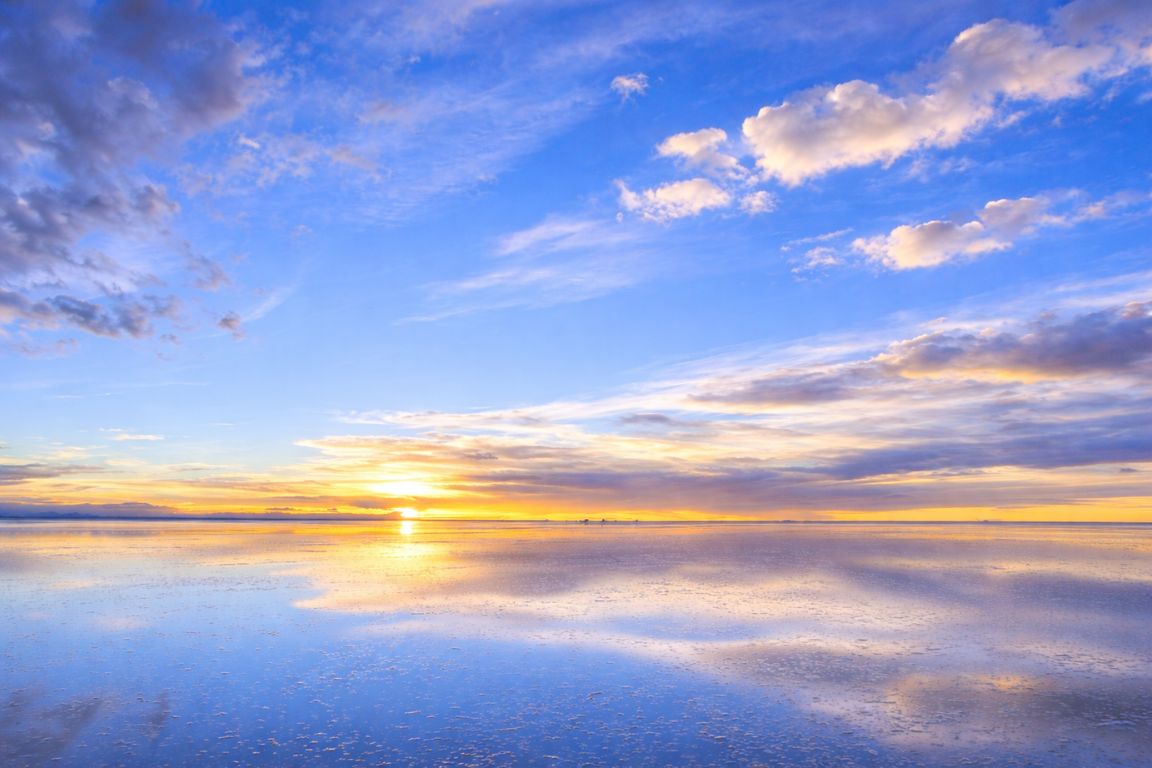 Mirror photography at the Salar requires the camera as close to the water surface as possible – the same ground-level logic as perspective shots, but for a different reason. The lower the camera, the more water surface enters the frame, and the more symmetrical the reflection becomes. Remove the polarizing filter completely – it cuts reflections and will kill the effect. Shoot at golden hour when the warm light colors both the sky and the reflection. Compose with the horizon line in the center of the frame or slightly off-center, not at the bottom third. Use a wide-angle lens and focus on infinity or the subject, not the water surface itself.
The polarizing filter mistake is so common it deserves its own paragraph. A polarizing filter works by blocking polarized light which is exactly the light that creates reflections. When you put a polarizing filter on in dry season, you reduce glare off the salt and get richer colors. When you put it on in wet season while trying to shoot reflections, you largely eliminate the reflection. The water surface goes from a mirror to a murky transparency. Remove the filter for every mirror shot. This trips up experienced photographers who’ve brought their filter kit and automatically reach for the polarizer to manage the Altiplano glare.
Composing mirror shots is a different problem than most photographers expect. The instinct is to put the horizon line at the top of the frame so the reflection fills the image. This often produces a less interesting image than splitting the frame almost in half – horizon in the center, equal parts sky and reflection. The symmetry of a perfect mirror is strongest when the composition acknowledges it directly. A single person standing at the horizon line, surrounded by reflected sky above and below, reads as extraordinary. The same person at the bottom of the frame with reflection filling three-quarters reads as less resolved.
Wind timing is critical. Sunrise is almost always calmer than any other time of day. The thermal dynamics of the high-altitude desert produce stronger wind as the sun heats the surface – by mid-morning a perfectly still dawn surface may already be showing ripples. Get on the flat as early as possible and position yourself in zones where the guide knows wind protection exists from the flat’s natural geography. When a gust comes through and ripples the surface, wait. The surface goes still again in seconds. The best frames come from the moments between gusts rather than requiring completely windless conditions throughout.
For night mirror photography – the reflection of the Milky Way in the wet-season water – the settings are the same as standard astrophotography but with the additional composition challenge of framing both the sky and its reflection. Use a wide-angle lens that captures a large vertical field of view. Set your camera on a tripod with the legs in the water if necessary. Expose for the sky (20-30 seconds, f/2.8 or faster, ISO 1600-6400) and accept that the reflection may be slightly underexposed compared to the sky above. In post-processing, lift the shadows in the reflection carefully. The doubled image of the Milky Way above and below is genuinely one of the most extraordinary compositions available anywhere in travel photography.
Curious about mirror timing? Here’s the best time to visit Salar de Uyuni tours for the mirror effect – which months deliver the reflection everyone wants and when water levels cooperate with tour access.
What Are the Best Conditions and Times of Day for Each Type of Shot?
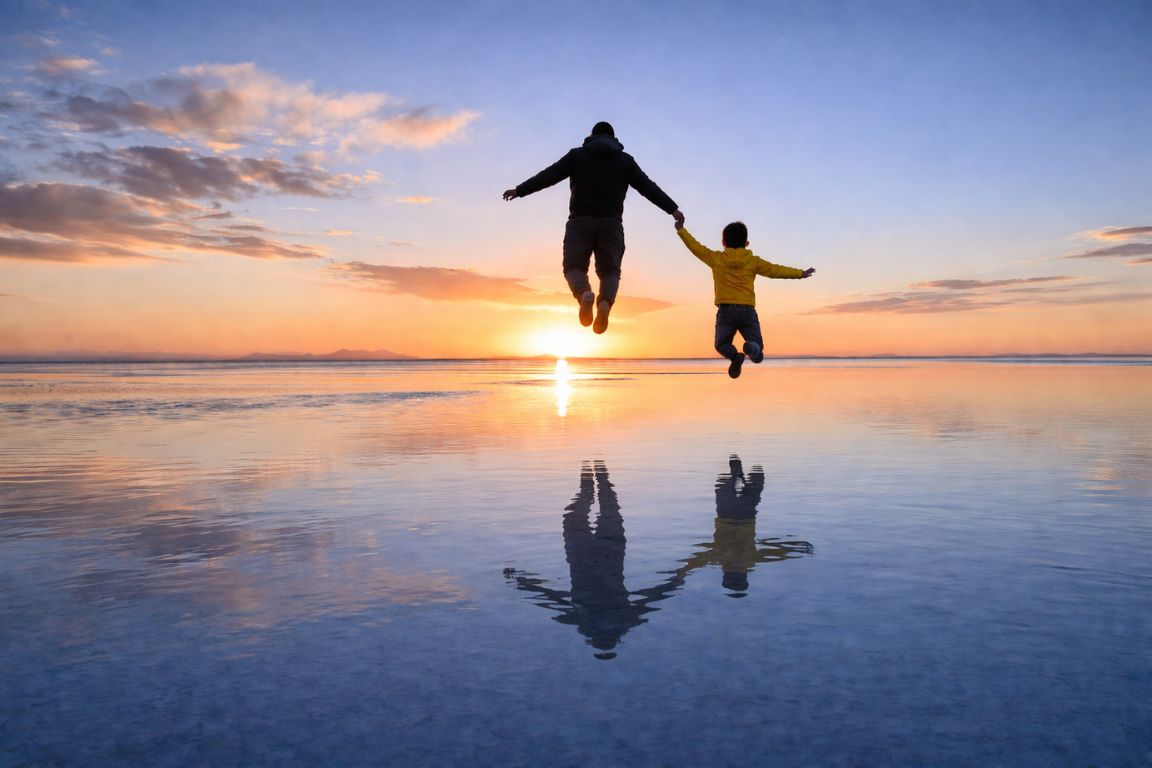 The most important timing principle at the Salar is that the flat looks completely different every 20 minutes during the first and last hour of daylight. The white salt shifts from pink to orange to gold to blinding white in the morning, then reverses at night. Midday light is harsh and produces flat, overexposed-looking results in almost every shot type. Plan all serious photography around the two golden hours – the 45 minutes after sunrise and the 45 minutes before sunset. The exception is forced-perspective work, which benefits from the even diffuse light of mid-morning when shadows are short.
Season determines which shot types are available. Dry season (May to October) gives you the hexagonal salt crust, long straight-line shadow shots at sunset, forced-perspective conditions all day, and the clearest possible sky for astrophotography. Wet season (December to April) adds mirror photography and the doubled-sky night shot, but eliminates most forced-perspective work because the water surface is not a blank reference plane in the same way the dry crust is. The salt patterns visible through shallow water can be interesting on their own, but they read differently than the pure white void the perspective tricks depend on.
Not all months deliver the same salt flat. The best time to visit Salar de Uyuni tours changes dramatically based on whether there’s water on the surface creating mirrors or dry salt stretching to the horizon.
| Pre-dawn (5:00-5:30am) | Cold, stars fading – transition moment | Surface at stillest – best mirror odds | Blue hour mirror shots, last star photos |
| Sunrise (5:30-6:30am) | Pink light on white crust – extraordinary color | Best mirror conditions – warm light in reflection | Landscape, mirror, hexagon textures |
| Mid-morning (8:00-11:00am) | Even light – best for perspective shots | Wind often building, mirror may degrade | Perspective shots, prop shots, portraits |
| Midday (11am-3pm) | Harsh, blinding – difficult to manage exposure | Same – generally avoid for serious photography | Shadow photos if overcast; rest otherwise |
| Late afternoon (3:00-5:30pm) | Shadow lines lengthening – great for groups | Wind often at peak – mirror usually gone | Shadow compositions, wide landscape |
| Sunset (5:30-6:30pm) | Rich warm light on white – spectacular | Wind may drop – late mirror possible | Landscape, silhouettes, last mirror attempt |
| Night (8pm-4am) | Clearest skies of year – Milky Way strong | Milky Way plus reflection if water present | Astrophotography, light painting, star trails |
One timing tip almost no guide covers: the 10 minutes immediately before the sun clears the mountains on a still wet-season morning. The sky is already illuminated and reflecting in the water, but the surface has not yet had any wind. The light is a deep blue transitioning to the first pink of sunrise. The colors in the reflection are richer and more complex than anything produced once the sun is fully up. This is a short window and it requires being on the flat before official sunrise which means a 4:30am departure from Uyuni town or arranged transport from a Colchani salt hotel. The photos from that window look like nothing else available at the flat.
How Do You Shoot the Milky Way and Night Sky at the Salar de Uyuni?
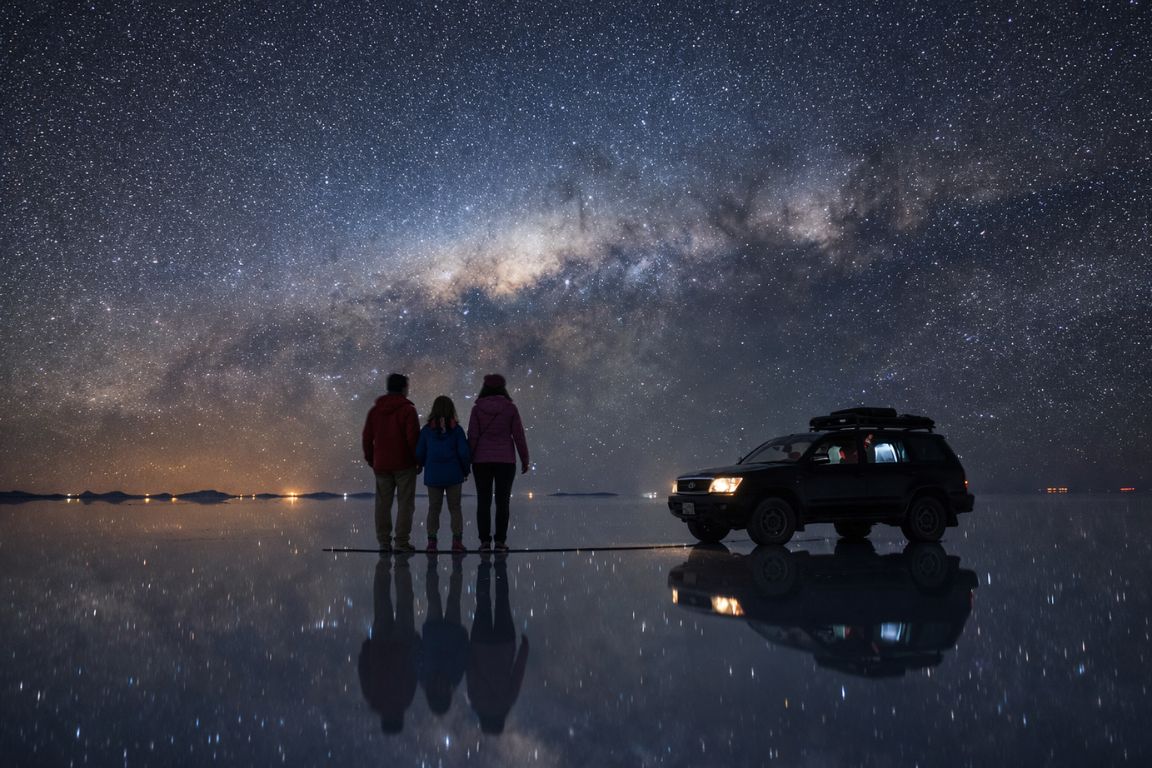 The Salar de Uyuni is one of the best astrophotography locations on earth. At 3,656 meters with little light pollution away from settlements in any direction and thin dry Altiplano air, the Milky Way is visible to the naked eye on any clear moonless night. The technical requirements are specific: tripod, fast wide-angle lens (f/2.8 or faster), shutter speeds of 20 to 30 seconds, ISO between 1600 and 6400, and manual focus set to infinity. Plan around new moon nights for the darkest sky. The Milky Way core is visible in the Southern Hemisphere from roughly January to October, with peak visibility from April to September.
The 500 Rule is the standard starting point for preventing star trails: divide 500 by your focal length to get the maximum shutter speed in seconds before stars begin to elongate. At 14mm, that’s about 35 seconds. At 24mm, about 21 seconds. Start there and experiment – modern cameras handle higher ISOs better than older guides suggest, so don’t be afraid of ISO 3200 or 6400 if your sensor handles it cleanly. Shoot RAW so you can recover detail in post. Take multiple frames and review on the LCD, zooming into a star to confirm focus before committing to a full session.
Focus for astrophotography is where most beginners struggle. Set the lens to manual focus. Turn on live view and zoom the display to 100% on a bright star. Slowly turn the focus ring until the star is a sharp point rather than a soft blob. Lock focus there. Don’t touch autofocus after this – the system will try to hunt and will miss. Use a remote shutter release or self-timer to trigger the shutter without touching the camera. Even a light touch on the body will introduce blur across a 25-second exposure.
The wet-season doubled-sky shot is technically the same as standard astrophotography but with a compositional decision to make: how much of the frame to give the sky versus the reflection. The most compelling images typically give roughly equal weight to both – the Milky Way arching above, its exact twin arching below in the water. Include a foreground element as an anchor: a person with a headlamp pointed upward, the silhouette of the 4×4 on the horizon, a salt mound. Without any anchor, the image reads as abstract and loses the sense of scale that makes the Salar astrophotos so powerful.
Plan around the lunar calendar. A full moon makes astrophotography almost impossible – the moon outcompetes the stars. New moon nights provide the darkest conditions. The best scenario is three to five days either side of new moon, when there’s no moon visible after dark. Use apps like PhotoPills or Stellarium to find the exact time the Milky Way core will rise at Uyuni’s coordinates on your specific date. Plan to be on the flat at that time, not after. By the time most tours get organized after dinner, the best astrophotography window is often already closing.
For serious astrophotographers, staying at a Colchani salt hotel removes the hour-long jeep ride from Uyuni town at midnight. Being 50 meters from the water’s edge when conditions align is a significant advantage. Questions about planning a photography-specific tour around night conditions?
Wondering about lodging options? Check out our guide on where to stay in Salar de Uyuni tours – the town is extremely basic but salt hotels offer unique (if cold) experiences on the flats themselves.
What Are the Most Common Photography Mistakes at the Salar de Uyuni?
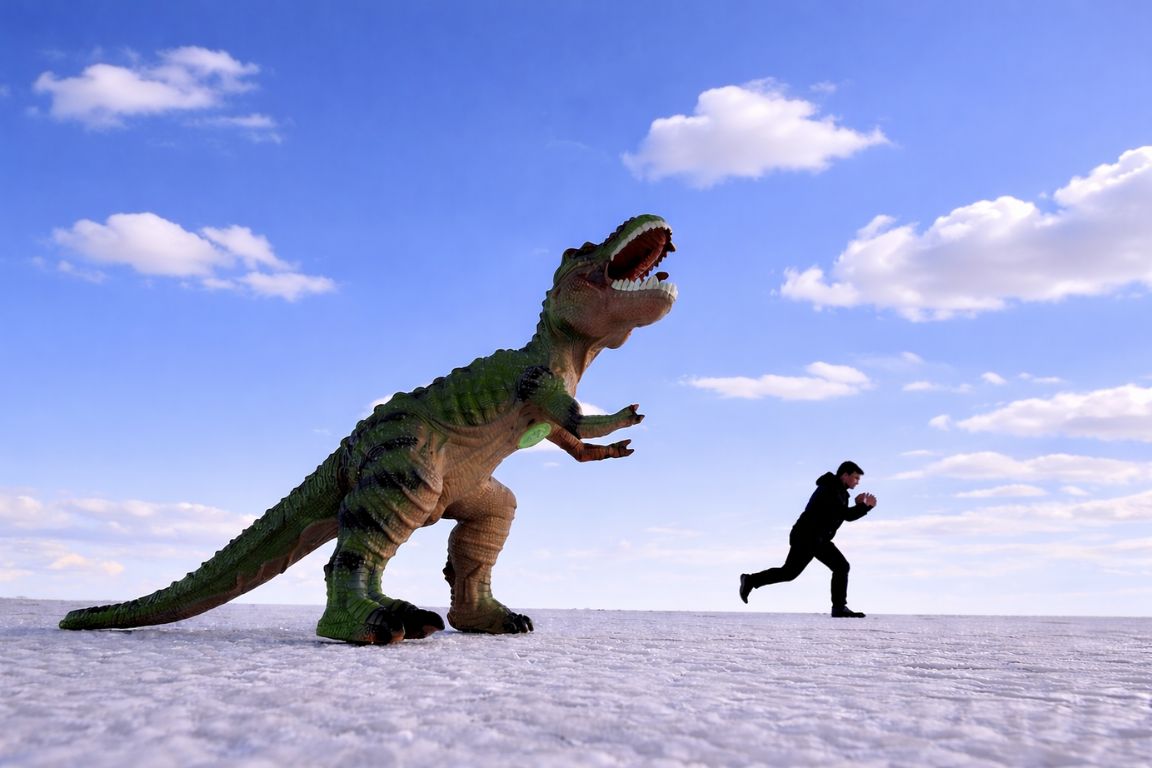 The most consistent mistake across every type of photography here is not getting the camera low enough. For perspective shots, people crouch when they should be lying flat. For mirror shots, they hold the camera at waist height when it should be centimeters from the water surface. For landscape shots, they stand when a low angle would include more of the flat in the frame and create a stronger sense of scale. The Salar rewards photographers who are willing to get dirty, get uncomfortable, and get their equipment as close to the surface as possible. The best shots come from commitment to the position.
Trusting automatic exposure on the white flat is a very common second mistake. The camera’s metering system is designed for scenes with a normal range of tones. A large area of white salt against a deep blue sky is not a normal scene. Almost every auto-exposure measurement will underexpose the salt, making it look grey. The result is a photo that looks flat, dingy, and nothing like the blinding white the flat actually appears. Apply positive exposure compensation – typically +1 to +2 stops – and check the histogram. The salt highlights should sit near the right edge without clipping.
Using the polarizing filter for mirror shots. Already covered above, but worth repeating because it happens constantly. The polarizer is the right tool for dry-season glare. It’s the wrong tool for anything involving reflections. Remove it before you approach the water. Confirm it’s off before every wet-surface shot.
Arriving without props for perspective shots. Tours include guides who sometimes have props, but their ideas and yours may differ. Guides have seen thousands of visitors and tend toward the standard shots – dinosaur attacking a person, person in a bottle. These are fine, but they’re not yours. The most interesting perspective photos at the Salar come from travelers who brought something specific to their own story: a miniature version of something they care about, a piece of their home country, something unexpected. Think about this before you board the bus for Uyuni.
Shooting only in the middle of the tour. The jeep stops at the perspective photo spot usually during mid-morning or early afternoon – reasonable light but not extraordinary. Sunrise and sunset are when the flat transforms. If the only photography you do is at the designated tour stops during designated hours, you’re leaving 80% of the Salar’s photographic potential untouched. Treat the main tour as a reconnaissance mission and return for the light.
Not protecting gear from salt. Taking a camera out to the wet flat and then packing it into a bag without wiping it down. Coming home and finding corrosion in the battery compartment three weeks later. This is avoidable with a microfiber cloth and five minutes of attention after every session on the salt. Don’t skip it.
If you’re trying to figure out appropriate gear, here’s what to wear in Salar de Uyuni tours so you handle the cold mornings, scorching midday sun, and freezing nights at extreme altitude.
Planning Takeaways For Your Trip
Choose the itinerary around the experience you want, the time you have and the actual services included. Check the guide language, transport, overnight arrangements and extra costs on the selected listing.
Frequently Asked Questions
Can I take good photos at the Salar de Uyuni with just a smartphone?
Yes. The flat’s dramatic light, extreme flatness, and visual simplicity make it one of the best smartphone photography locations on earth. Use the wide lens, tap to adjust exposure (hold your finger on a bright area to prevent overexposure), and shoot during golden hour. Clean the lens before every session – fingerprint smear is far more damaging to your photos than the hardware. For perspective shots and mirror shots, the technique is identical to what you’d use with a camera: get the phone at ground level.
Do I need a polarizing filter at the Salar de Uyuni?
In dry season, a circular polarizing filter helps manage glare off the white salt and deepens the blue of the sky. In wet season, remove it entirely for any mirror or reflection shot – the filter eliminates reflections, which is exactly what you’re trying to capture. Never use it for astrophotography.
When is the Milky Way visible at the Salar de Uyuni?
The Milky Way core is visible from the Southern Hemisphere from roughly January to October. Peak visibility falls between April and September. Plan around new moon nights for the darkest sky. The dry season (May to October) offers the clearest atmospheric conditions for astrophotography. The wet season adds the possibility of reflecting the Milky Way in shallow water – one of the most extraordinary shots in travel photography.
What size props work best for forced-perspective photos?
Medium-sized objects. Toy dinosaurs (widely available in Uyuni’s shops), wine or beer bottles, Pringles cans, boots, and small figures all work well. Very small objects create focus and depth-of-field problems that force compromises. The prop needs to be large enough that the lens can focus on it while still keeping the background human subject in acceptable sharpness. Use a small aperture (f/8 to f/11) to maximize depth of field across both foreground and background subjects.
How do I protect my camera from salt damage at the Salar de Uyuni?
Keep the camera in a sealed bag between shooting sessions. Wipe the body and lenses with a dry microfiber cloth after every session on the flat. Never use wet wipes directly on lens elements. In wet season, pay particular attention to ports, battery compartments, and lens mounts – salt water is actively corrosive. Store equipment sealed when not in use and clean thoroughly at the end of each flat day.
Is it worth booking a dedicated photography tour at the Salar de Uyuni?
For serious photographers, yes. Dedicated photography tours offer sunrise starts, flexible timing at each stop, guides who understand positioning and composition rather than standard tour routines, and the ability to extend time at locations that are working. Operators like Hodaka and Brisa Tours in Uyuni specifically run mirror and stargazing sessions timed around conditions rather than fixed schedules.
Choose Your Uyuni Experience
Set your photography date before arranging onward transport. Start with the daylight-and-sunset route, or adjust for reflections and the night sky below.
Initial editorial recommendation. No preferences have been entered.
Salt Flats And Sunset Day Trip
A full salt-flat day with lunch, an English-speaking guide and sunset.
Rain boots included; Incahuasi entry costs extra. Colchani hotel pickup has a surcharge.Scheduled dates load automatically. Availability and final price are confirmed on Viator.
No verified tour meets all of these preferences. Adjust the choices below or reset.
Compare Options And Tailor Your Choice
- Two Days On The Salt Flats (2 days): An overnight salt-flat route with sunset, a hostel stay and an English-speaking driver-guide. Park and museum fees, water and snacks cost extra. Mirror reflections depend on surface water.
- Private Starlight And Sunrise (4–5 hours): A private outing for the salt-flat night sky and sunrise, with hotel pickup and hot drinks. Confirm the departure time: the listing contains conflicting time details. Clear skies and reflections are not guaranteed.
- Sunset And Starlights (4 hours): Watch sunset and stay for the night sky on a four-hour outing from Uyuni. Choose the guide language when booking. Waterproof wellies are listed; skies and reflections depend on conditions. Age eligibility must be confirmed.
Affiliate links: we may earn a commission when you book, at no extra cost to you.